
Join Our JEE Preparation Group
Prep with like-minded aspirants; Get access to free daily tests and study material.
Sign in
Please select an account to continue using cracku.in
↓ →
Join Our JEE Preparation Group
Prep with like-minded aspirants; Get access to free daily tests and study material.
A double slit setup is shown in the figure. One of the slits is in medium 2 of refractive index $$n_2$$. The other slit is at the interface of this medium with another medium 1 of refractive index $$n_1$$ ($$\neq n_2$$). The line joining the slits is perpendicular to the interface and the distance between the slits is $$d$$. The slit widths are much smaller than $$d$$. A monochromatic parallel beam of light is incident on the slits from medium 1. A detector is placed in medium 2 at a large distance from the slits, and at an angle $$\theta$$ from the line joining them, so that $$\theta$$ equals the angle of refraction of the beam. Consider two approximately parallel rays from the slits received by the detector.
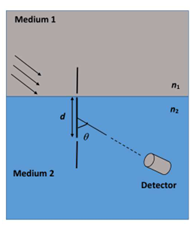
Which of the following statement(s) is (are) correct?
Using Snell's law, the angle of refraction of the incident beam in medium 2 is $$\theta$$.
Evaluating optical path difference before the slits between $$S_1$$ and $$S_2$$:
$$\Delta x_1 = n_2 d \cos\theta$$
Evaluating optical path difference after the slits to the far detector at angle $$\theta$$:
$$\Delta x_2 = -n_2 d \cos\theta$$
$$\Delta x_{\text{total}} = \Delta x_1 + \Delta x_2 = n_2 d \cos\theta - n_2 d \cos\theta = 0$$
$$\Delta \phi = \frac{2\pi}{\lambda_0} \Delta x_{\text{total}} = 0$$
Since $$\Delta \phi = 0$$, the phase difference is completely independent of $$d$$ and the rays interfere constructively.
Answer: Option (A), Option (B)
Was this solution helpful?
Create a FREE account and get:
_1.webp)

Educational materials for JEE preparation

Ask our AI anything

AI can make mistakes. Please verify important information.
AI can make mistakes. Please verify important information.
