
Join Our JEE Preparation Group
Prep with like-minded aspirants; Get access to free daily tests and study material.
Sign in
Please select an account to continue using cracku.in
↓ →
Join Our JEE Preparation Group
Prep with like-minded aspirants; Get access to free daily tests and study material.
In the given P-V diagram, a monoatomic gas $$\left(\gamma = \dfrac{5}{3}\right)$$ is first compressed adiabatically from state A to state B. Then it expands isothermally from state B to state C. [Given: $$\left(\dfrac{1}{3}\right)^{0.6} = 0.5$$, ln 2 $$\simeq$$ 0.7].
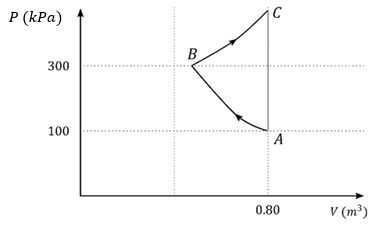
Which of the following statement(s) is(are) incorrect?
Work done in an adiabatic process is given by $$W = \frac{P_A V_A - P_B V_B}{\gamma - 1}$$, and for an isothermal process it is given by $$W = P_B V_B \ln\left(\frac{V_C}{V_B}\right)$$.
Given: $$P_A = 100\text{ kPa}$$, $$V_A = 0.80\text{ m}^3$$, $$P_B = 300\text{ kPa}$$, $$\gamma = \frac{5}{3}$$, $$\left(\frac{1}{3}\right)^{0.6} = 0.5$$, $$\ln 2 \approx 0.7$$
Along adiabatic compression $$A \rightarrow B$$:
$$P_A V_A^\gamma = P_B V_B^\gamma \implies V_B = V_A \left(\frac{P_A}{P_B}\right)^{1/\gamma} = 0.80 \left(\frac{1}{3}\right)^{0.6} = 0.80 \times 0.5 = 0.40\text{ m}^3$$
$$W_{A \rightarrow B} = \frac{100 \times 0.80 - 300 \times 0.40}{\frac{5}{3} - 1} = \frac{80 - 120}{\frac{2}{3}} = -60\text{ kJ} \implies \vert{}W_{A \rightarrow B}\vert{} = 60\text{ kJ}$$
Along isothermal expansion $$B \rightarrow C$$ (where $$V_C = V_A = 0.80\text{ m}^3$$):
$$W_{B \rightarrow C} = P_B V_B \ln\left(\frac{V_C}{V_B}\right) = 300 \times 0.40 \ln\left(\frac{0.80}{0.40}\right) = 120 \ln 2 = 120 \times 0.7 = 84\text{ kJ}$$
Along isochoric path $$C \rightarrow A$$:
$$W_{C \rightarrow A} = 0$$
Total work done $$A \rightarrow B \rightarrow C$$:
$$W_{\text{total}} = W_{A \rightarrow B} + W_{B \rightarrow C} = -60 + 84 = 24\text{ kJ}$$
Was this solution helpful?
Create a FREE account and get:
_1.webp)

Educational materials for JEE preparation

Ask our AI anything

AI can make mistakes. Please verify important information.
AI can make mistakes. Please verify important information.
