
Join Our JEE Preparation Group
Prep with like-minded aspirants; Get access to free daily tests and study material.
Sign in
Please select an account to continue using cracku.in
↓ →
Join Our JEE Preparation Group
Prep with like-minded aspirants; Get access to free daily tests and study material.
A flat surface of a thin uniform disk A of radius R is glued to a horizontal table. Another thin uniform disk B of mass M and with the same radius R rolls without slipping on the circumference of A, as shown in the figure. A flat surface of B also lies on the plane of the table. The center of mass of B has fixed angular speed $$\omega$$ about the vertical axis passing through the center of A. The angular momentum of B is $$nM\omega R^2$$ with respect to the center of A. Which of the following is the value of $$n$$?
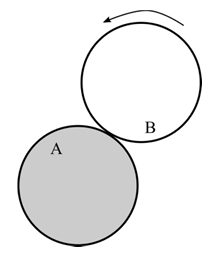
Since both the orbital revolution and the intrinsic spin occur in the same direction (counter-clockwise), their magnitudes add up directly:
$$L_{\text{total}} = L_{\text{orbital}} + L_{\text{spin}}$$
$$L_{\text{total}} = 4M\omega R^2 + M\omega R^2 = 5M\omega R^2$$
Comparing our result with the expression given in the problem, $$n M \omega R^2$$:
$$n M \omega R^2 = 5 M \omega R^2 \implies n = 5$$
Was this solution helpful?
Create a FREE account and get:
_1.webp)

Educational materials for JEE preparation

Ask our AI anything

AI can make mistakes. Please verify important information.
AI can make mistakes. Please verify important information.
