
Join Our JEE Preparation Group
Prep with like-minded aspirants; Get access to free daily tests and study material.
Sign in
Please select an account to continue using cracku.in
↓ →
Join Our JEE Preparation Group
Prep with like-minded aspirants; Get access to free daily tests and study material.
Two particles, of masses $$M$$ and $$2M$$, moving, as shown, with speeds of $$10m/s$$ and $$5m/s$$, collide elastically at the origin. After the collision, they move along the indicated directions with speeds $$υ_1$$ and $$υ_2$$, respectively. The values of $$υ_1$$ and $$υ_2$$ are nearly :
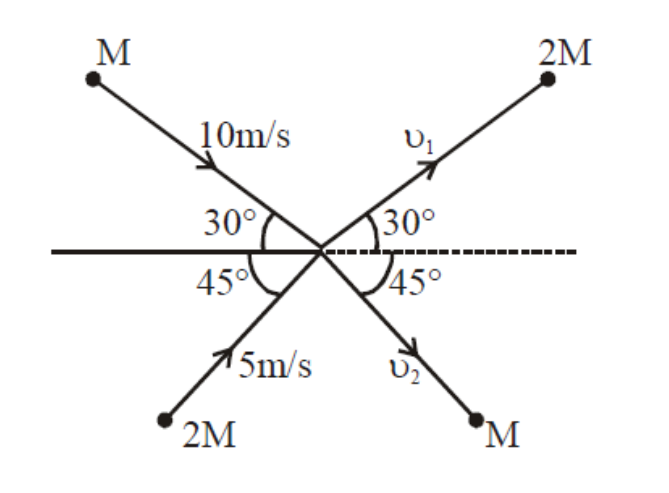
In a two-dimensional elastic collision, the total linear momentum along both the $$x$$-axis and $$y$$-axis is independently conserved.
$$M \times 10 \cos 30^\circ + 2M \times 5 \cos 45^\circ$$
$$= 2M \times V_1 \cos 30^\circ + MV_2 \cos 45^\circ$$
$$5\sqrt{3} + 5\sqrt{2} = 2v_1 \frac{\sqrt{3}}{2} + \frac{v_2}{\sqrt{2}}$$
$$10 \times M \sin 30^\circ - 2M \times 5 \sin 45^\circ$$
$$= Mv_2 \sin 45^\circ - 2Mv_1 \sin 30^\circ$$
$$5 - 5\sqrt{2} = \frac{v_2}{\sqrt{2}} - v_1$$
$$\text{Solving } v_1 = \frac{17.5}{2.7} \simeq 6.5\text{ m/s}$$
$$v_2 \approx 6.3\text{ m/s}$$
Was this solution helpful?
Create a FREE account and get:
_1.webp)

Educational materials for JEE preparation

Ask our AI anything

AI can make mistakes. Please verify important information.
AI can make mistakes. Please verify important information.
