Sign in
Please select an account to continue using cracku.in
↓ →
 CAT WhatsApp Group
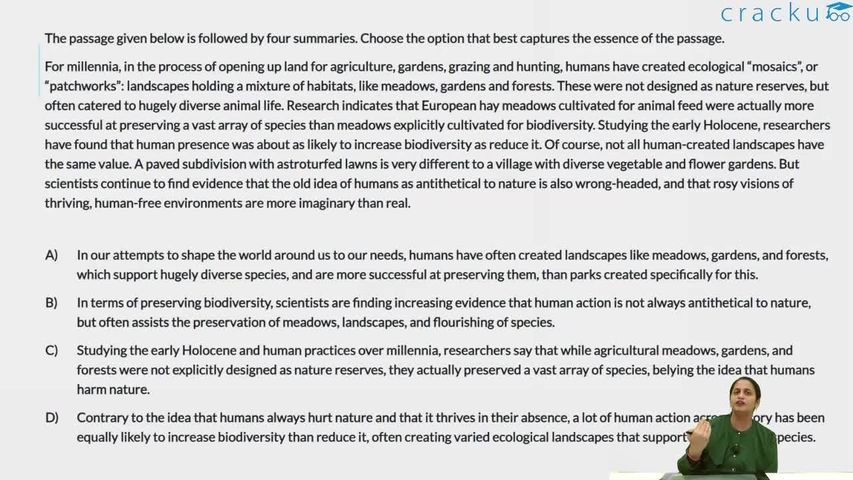
The passage given below is followed by four summaries. Choose the option that best captures the essence of the passage.
For millennia, in the process of opening up land for agriculture, gardens, grazing and hunting, humans have created ecological “mosaics”, or “patchworks”: landscapes holding a mixture of habitats, like meadows, gardens and forests. These were not designed as nature reserves, but often catered to hugely diverse animal life. Research indicates that European hay meadows cultivated for animal feed were actually more successful at preserving a vast array of species than meadows explicitly cultivated for biodiversity. Studying the early Holocene, researchers have found that human presence was about as likely to increase biodiversity as reduce it. Of course, not all human-created landscapes have the same value. A paved subdivision with astroturfed lawns is very different to a village with diverse vegetable and flower gardens. But scientists continue to find evidence that the old idea of humans as antithetical to nature is also wrong-headed, and that rosy visions of thriving, human-free environments are more imaginary than real.

The main idea of the passage is that the belief that humans always harm nature is not accurate. Throughout history, people have often created diverse landscapes that support many species. Research shows that human presence can increase biodiversity just as much as it can decrease it. The passage also questions the idea that nature only does well when people are not around.
Option D best sums up the main idea. It clearly contrasts the old belief that humans always harm nature and that nature does best without people, with the newer view that humans have often helped increase biodiversity. It also mentions the creation of different types of landscapes, matching the argument and balance of the passage.
The other options do not sum up the passage as completely as Option D. Option A is too narrow and focuses too much on people shaping nature on purpose, missing the bigger point about the human-versus-nature idea. Option B is too vague and does not include the history or the idea of mixed landscapes. Option C is closer, but it is too specific and only talks about certain times and actions, so it does not fully show the passage’s main message about how we view humans and nature.
Click on the Email ☝️ to Watch the Video Solution
Create a FREE account and get:
Book Free CAT Mentorship
Get personalized CAT strategy from a 99%iler
500+ students mentored
OTP Verification
Enter the 6-digit code sent to your phone
Booking Summary
Enter OTP
Didn't receive the OTP?

Educational materials for CAT preparation

Ask our AI anything

AI can make mistakes. Please verify important information.
AI can make mistakes. Please verify important information.
 91- 6303239042


