
Join Our JEE Preparation Group
Prep with like-minded aspirants; Get access to free daily tests and study material.
Sign in
Please select an account to continue using cracku.in
↓ →
Join Our JEE Preparation Group
Prep with like-minded aspirants; Get access to free daily tests and study material.
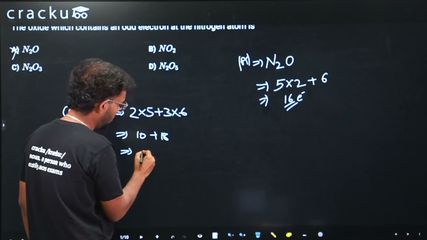
We need to identify which nitrogen oxide contains an odd electron at the nitrogen atom.
Key Concept: An odd-electron molecule has an odd total number of valence electrons, which means at least one electron must remain unpaired.
Option A: $$N_2O$$ (Nitrous oxide)
Total valence electrons = $$2 \times 5 + 6 = 16$$ (even).
Lewis structure: $$:N=N=O:$$ (linear, with resonance structures $$:\!N \equiv N - O\!:$$ and $$:N - N \equiv O:$$). All 16 electrons are paired. No unpaired electron on nitrogen.
Option B: $$NO_2$$ (Nitrogen dioxide)
Total valence electrons = $$5 + 2 \times 6 = 17$$ (odd).
Since 17 is odd, one electron must remain unpaired. The Lewis structure of $$NO_2$$ is drawn as follows:
Nitrogen is the central atom bonded to two oxygen atoms. One N=O double bond uses 4 electrons, one N-O single bond uses 2 electrons. Each oxygen gets lone pairs to complete its octet: the double-bonded O has 2 lone pairs (4 electrons), the single-bonded O has 3 lone pairs (6 electrons). This accounts for $$4 + 2 + 4 + 6 = 16$$ electrons. The remaining 1 electron (the 17th) sits on the nitrogen atom as an unpaired electron.
This unpaired electron makes $$NO_2$$ paramagnetic and gives it a bent geometry with a bond angle of about $$134°$$.
Option C: $$N_2O_3$$ (Dinitrogen trioxide)
Total valence electrons = $$2 \times 5 + 3 \times 6 = 28$$ (even).
$$N_2O_3$$ can be viewed as $$NO + NO_2$$ combined through an N-N bond: $$O=N-N(=O)-O$$. All 28 electrons are paired in the bonding and lone pair positions. No unpaired electron.
Option D: $$N_2O_5$$ (Dinitrogen pentoxide)
Total valence electrons = $$2 \times 5 + 5 \times 6 = 40$$ (even).
Structure: $$O_2N-O-NO_2$$. All 40 electrons are paired. No unpaired electron.
Among all the given oxides, only $$NO_2$$ has an odd number of valence electrons (17). The single unpaired electron resides on the nitrogen atom, making it an odd-electron species.
The correct answer is Option B: $$NO_2$$.
Was this solution helpful?
Click on the Email ☝️ to Watch the Video Solution
_1.webp)

Educational materials for JEE preparation

Ask our AI anything

AI can make mistakes. Please verify important information.
AI can make mistakes. Please verify important information.