The number of radial and angular nodes in $$4d$$ orbital are, respectively

Join Our JEE Preparation Group
Prep with like-minded aspirants; Get access to free daily tests and study material.
Sign in
Please select an account to continue using cracku.in
↓ →
Join Our JEE Preparation Group
Prep with like-minded aspirants; Get access to free daily tests and study material.
The number of radial and angular nodes in $$4d$$ orbital are, respectively
Login to view the detailed solution.
Which of the following is a metalloid?
Loading solution...
The oxide which contains an odd electron at the nitrogen atom is
Loading solution...

Which one of the following is an example of disproportionation reaction?
Loading solution...
Boiling of hard water is helpful in removing the temporary hardness by converting calcium hydrogen carbonate and magnesium hydrogen carbonate to
Loading solution...
s-block element which cannot be qualitatively confirmed by the flame test is
Loading solution...

The correct order of nucleophilicity is
Loading solution...
The major product of the following reaction is:
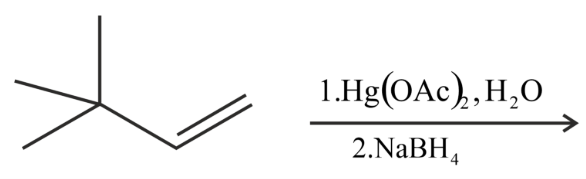
Loading solution...
Halogenation of which one of the following will yield m-substituted product with respect to methyl group as a major product?
Loading solution...

The measured BOD values for four different water samples (A - D) are as follows: A = 3 ppm; B = 18 ppm; C = 21 ppm; D = 4 ppm. The water samples which can be called as highly polluted with organic wastes, are
Loading solution...
The role of depressants in 'Froth Floation method' is to
Loading solution...
The most common oxidation state of Lanthanoid elements is $$+3$$. Which of the following is likely to deviate easily from $$+3$$ oxidation state?
Loading solution...

Toluene can be easily converted into benzaldehyde by which of the following reagents?
Loading solution...
The final product 'A' in the following reaction sequence
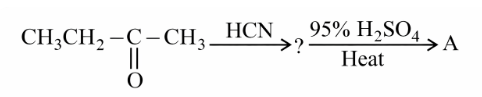
Loading solution...
The reagent, from the following, which converts benzoic acid to benzaldehyde in one step is
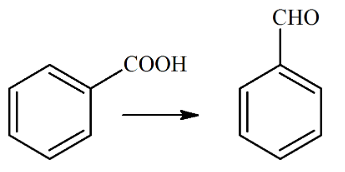
Loading solution...

Which statement is NOT correct for p-toluenesulphonyl chloride?
Loading solution...
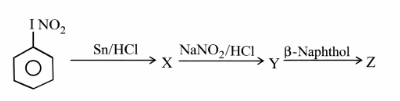
Identify 'Z' among the following
Loading solution...
Match List I with List II.
| List-I (Enzyme) | List-II (Conversion of) |
|---|---|
| A. Invertase | I. Starch into maltose |
| B. Zymase | II. Maltose into glucose |
| C. Diastase | III. Glucose into ethanol |
| D. Maltase | IV. Cane sugar into glucose |
Choose the most appropriate answer from the options given below
Loading solution...

Which of the following is NOT an example of synthetic detergent?
Loading solution...
Which one of the following is a water soluble vitamin, that is not excreted easily?
Loading solution...
CNG is an important transportation fuel. When $$100$$ g CNG is mixed with $$208$$ g oxygen in vehicles, it leads to the formation of $$CO_2$$ and $$H_2O$$ and produces large quantity of heat during this combustion, then the amount of carbon dioxide, produced in grams is ______ [nearest integer] [Assume CNG to be methane]
Loading solution...
The moles of methane required to produce $$81$$ g of water after complete combustion is ______ $$\times 10^{-2}$$ mol. [nearest integer]
Loading solution...
Amongst $$SF_4, XeF_4, CF_4$$ and $$H_2O$$, the number of species with two lone pairs of electrons is ______
Loading solution...
A fish swimming in water body when taken out from the water body is covered with a film of water of weight $$36$$ g. When it is subjected to cooking at $$100°$$C, then the internal energy for vaporization in kJ mol$$^{-1}$$ is ______ [integer]
[Assume steam to be an ideal gas. Given $$\Delta_{vap}H^\circ$$ for water at $$373$$ K and $$1$$ bar is $$41.1$$ kJ mol$$^{-1}$$ : $$R = 8.31$$ J K$$^{-1}$$ mol$$^{-1}$$]
Loading solution...
$$40\%$$ of HI undergoes decomposition to $$H_2$$ and $$I_2$$ at $$300$$ K. $$\Delta G^\circ$$ for this decomposition reaction at one atmosphere pressure is ______ J mol$$^{-1}$$ [nearest integer]
(Use $$R = 8.31$$ J K$$^{-1}$$ mol$$^{-1}$$; $$\log 2 = 0.3010$$, $$\ln 10 = 2.3$$, $$\log 3 = 0.477$$)
Loading solution...
In a solid AB, A atoms are in ccp arrangement and B atoms occupy all the octahedral sites. If two atoms from the opposite faces are removed, then the resultant stoichiometry of the compound is $$A_xB_y$$. The value of $$x$$ is ______ [nearest integer]
Loading solution...
The osmotic pressure exerted by a solution prepared by dissolving $$2.0$$ g of protein of molar mass $$60$$ kg mol$$^{-1}$$ in $$200$$ mL of water at $$27°$$C is ______ Pa. [integer value] (use $$R = 0.083$$ L bar mol$$^{-1}$$ K$$^{-1}$$)
Loading solution...
$$Cu(s) + Sn^{2+}(0.001M) \to Cu^{2+}(0.01M) + Sn(s)$$
The Gibbs free energy change for the above reaction at $$298$$ K is $$x \times 10^{-1}$$ kJ mol$$^{-1}$$. The value of $$x$$ is ______ [nearest integer]
[Given : $$E^\circ_{Cu^{2+}/Cu} = 0.34$$ V; $$E^\circ_{Sn^{2+}/Sn} = -0.14$$ V; $$F = 96500$$ C mol$$^{-1}$$]
Loading solution...
Catalyst A reduces the activation energy for a reaction by $$10$$ kJ mol$$^{-1}$$ at $$300$$ K. The ratio of rate constants, $$\frac{k_T \text{ Catalysed}}{k_T \text{ Uncatalysed}}$$ is $$e^x$$. The value of $$x$$ is ______ [nearest integer] [Assume that the pre-exponential factor is same in both the cases. Given $$R = 8.31$$ J K$$^{-1}$$ mol$$^{-1}$$]
Loading solution...
Reaction of $$[Co(H_2O)_6]^{2+}$$ with excess ammonia and in the presence of oxygen results into a diamagnetic product. Number of electrons present in $$t_{2g}$$-orbitals of the product is ______
Loading solution...
Educational materials for JEE preparation
 Share