
Join Our JEE Preparation Group
Prep with like-minded aspirants; Get access to free daily tests and study material.
Sign in
Please select an account to continue using cracku.in
↓ →
Join Our JEE Preparation Group
Prep with like-minded aspirants; Get access to free daily tests and study material.
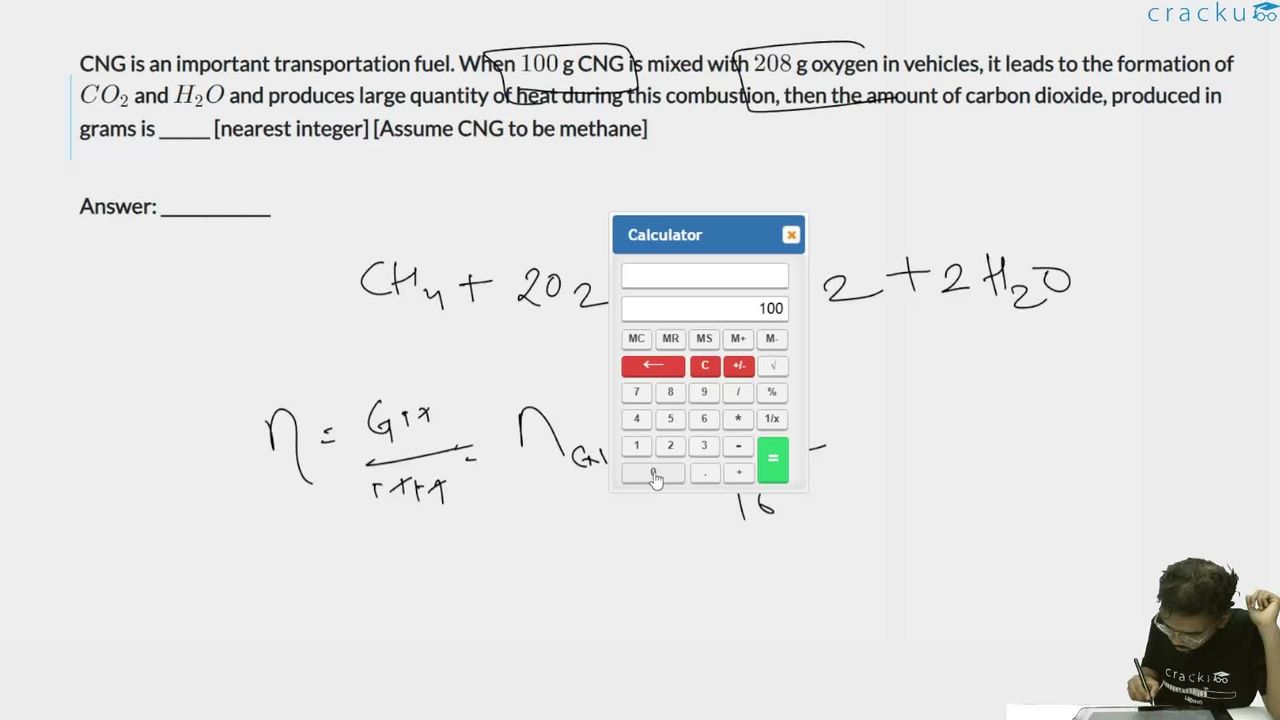
CNG is an important transportation fuel. When $$100$$ g CNG is mixed with $$208$$ g oxygen in vehicles, it leads to the formation of $$CO_2$$ and $$H_2O$$ and produces large quantity of heat during this combustion, then the amount of carbon dioxide, produced in grams is ______ [nearest integer] [Assume CNG to be methane]
Correct Answer: 143
We need to find the mass of $$CO_2$$ produced when 100 g of methane (CNG) is mixed with 208 g of oxygen.
The balanced chemical equation for the combustion of methane is $$CH_4 + 2O_2 \rightarrow CO_2 + 2H_2O$$.
The number of moles of methane present is calculated by dividing its mass by its molar mass: $$\frac{100}{16} = 6.25$$ mol.
The number of moles of oxygen available is determined similarly: $$\frac{208}{32} = 6.5$$ mol.
According to the balanced equation, one mole of methane requires two moles of oxygen. To fully react 6.25 moles of methane, $$6.25 \times 2 = 12.5$$ moles of oxygen would be needed, but only 6.5 moles are available.
Since oxygen is insufficient to react with all the methane, it is the limiting reagent.
The stoichiometry of the reaction indicates that two moles of oxygen produce one mole of carbon dioxide. Therefore, the moles of carbon dioxide formed are $$\frac{6.5}{2} = 3.25$$ mol.
Multiplying the moles of carbon dioxide by its molar mass gives the mass produced: $$3.25 \times 44 = 143$$ g.
Therefore, the amount of carbon dioxide produced is 143 g.
Was this solution helpful?
Click on the Email ☝️ to Watch the Video Solution
Create a FREE account and get:
_1.webp)

Educational materials for JEE preparation

Ask our AI anything

AI can make mistakes. Please verify important information.
AI can make mistakes. Please verify important information.
