
Join Our JEE Preparation Group
Prep with like-minded aspirants; Get access to free daily tests and study material.
Sign in
Please select an account to continue using cracku.in
↓ →
Join Our JEE Preparation Group
Prep with like-minded aspirants; Get access to free daily tests and study material.
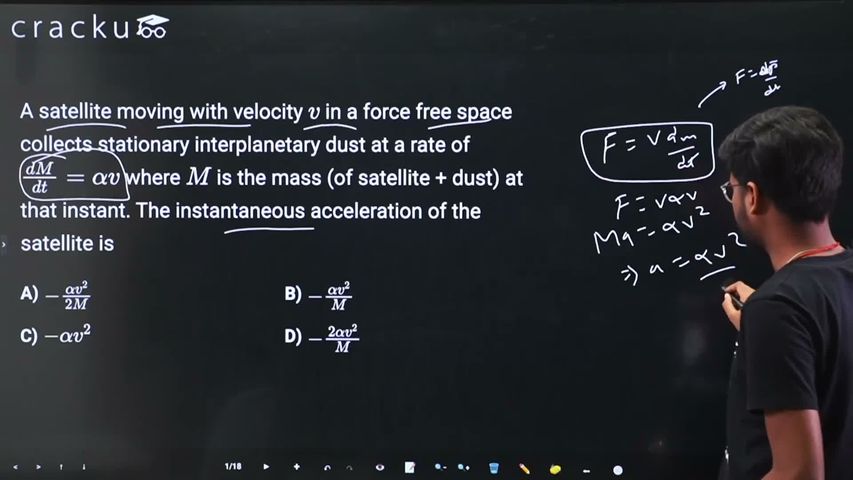
A satellite moving with velocity $$v$$ in a force free space collects stationary interplanetary dust at a rate of $$\frac{dM}{dt} = \alpha v$$ where $$M$$ is the mass (of satellite + dust) at that instant. The instantaneous acceleration of the satellite is
For a system with a changing mass configuration, the generalized thrust equation derived from Newton's Second Law is given by:
$$F_{\text{ext}} = M\frac{dv}{dt} - v_{\text{rel}}\frac{dM}{dt}$$
Where:
Let us evaluate the specific physical conditions given in the problem statement:
$$F_{\text{ext}} = 0$$
$$v_{\text{rel}} = v_{\text{dust}} - v = 0 - v = -v$$
Substituting these parameters into our variable mass framework yields:
$$0 = M\frac{dv}{dt} - (-v)\frac{dM}{dt}$$
$$M\frac{dv}{dt} + v\frac{dM}{dt} = 0 \implies M\frac{dv}{dt} = -v\frac{dM}{dt}$$
Isolate the acceleration parameter ($$a = \frac{dv}{dt}$$) from the dynamic equation:
$$a = -\frac{v}{M}\frac{dM}{dt}$$
We are given that the dust accumulation rate scales directly with velocity as $$\frac{dM}{dt} = \alpha v$$. Substituting this rate into the equation gives:
$$a = -\frac{v}{M}(\alpha v)$$
$$a = -\frac{\alpha v^2}{M}$$
Concept Check: The negative sign physically represents a retarding thrust force. As the satellite collides with and absorbs stationary dust particles, it must continuously transfer momentum to accelerate them up to its own speed, which consequently causes the satellite itself to decelerate.
Correct Option Key: Option B ($-\frac{\alpha v^2}{M}$)
Was this solution helpful?
Click on the Email ☝️ to Watch the Video Solution
Create a FREE account and get:
_1.webp)

Educational materials for JEE preparation

Ask our AI anything

AI can make mistakes. Please verify important information.
AI can make mistakes. Please verify important information.


