
Join Our JEE Preparation Group
Prep with like-minded aspirants; Get access to free daily tests and study material.
Sign in
Please select an account to continue using cracku.in
↓ →
Join Our JEE Preparation Group
Prep with like-minded aspirants; Get access to free daily tests and study material.
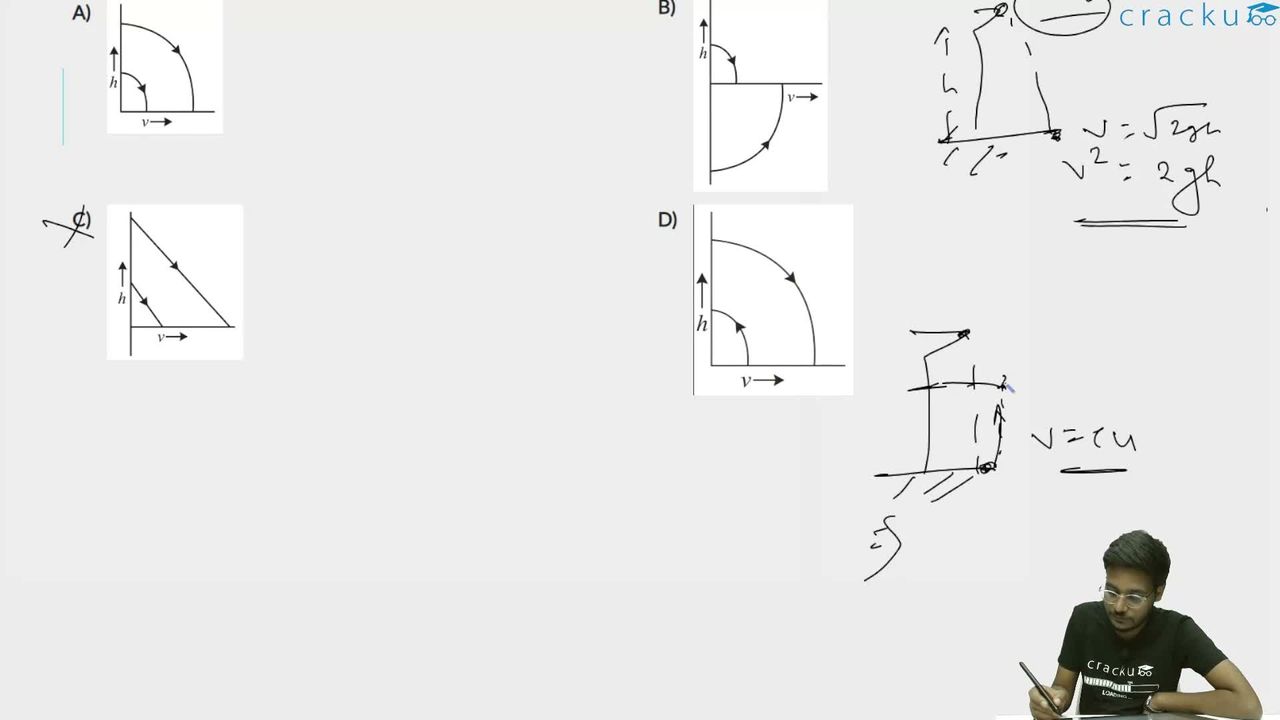
A ball is dropped vertically downwards from a height $$h$$ above the ground. It hits the ground inelastically and bounces up vertically. Neglecting subsequent motion and air resistance, which of the following graph represents variation between speed ($$v$$) and height ($$h$$) correctly?
For motion under uniform gravity (air resistance neglected) we can use the constant-acceleration relation
$$v^{2}=u^{2}+2g\,(h_{\text{initial}}-h)\qquad -(1)$$
Here $$h$$ is the vertical coordinate measured from the ground (origin at the ground, positive upward), $$u$$ is the speed when the particle is at height $$h_{\text{initial}}$$ and $$g$$ is the magnitude of acceleration due to gravity.
Case 1: Descent from the release point ($$h=H$$) to the ground ($$h=0$$)
The ball is dropped from rest, so $$u=0$$ at $$h=H$$.
Putting $$h_{\text{initial}}=H$$ and $$u=0$$ in (1):
$$v^{2}=2g\,(H-h)\qquad (0\le h\le H)$$
Thus $$v=\sqrt{2g\,(H-h)}$$, which is the upper half of a parabola on a $$v$$ vs $$h$$ plot. At the starting point $$h=H$$, $$v=0$$; just before impact $$h=0$$, $$v=\sqrt{2gH}$$ (maximum speed).
Case 2: Ascent after the inelastic bounce
Let the coefficient of restitution with the ground be $$e\,(0\lt e\lt 1)$$.
Speed just after the bounce (directed upward) is therefore $$e\sqrt{2gH}$$.
During upward motion the acceleration is still downward $$(-g)$$, so we again use (1) with $$u=e\sqrt{2gH}$$ at $$h=0$$:
$$v^{2}=e^{2}\,2gH-2g\,h\qquad (0\le h\le h_{\max})$$
where $$h_{\max}=e^{2}H$$ (height reached after bounce). Hence $$v=\sqrt{e^{2}2gH-2g\,h}\,,$$ another upper-parabolic branch but this time terminating at $$h=e^{2}H$$ where $$v=0$$.
Shape of the complete $$v$$-$$h$$ graph
1. From $$h=H$$ to $$h=0$$: a parabolic arc opening toward the $$h$$-axis, starting at $$v=0$$ and ending at $$v=\sqrt{2gH}$$.
2. Immediately after impact: vertical jump to the point $$h=0,\;v=e\sqrt{2gH}$$ (because direction has reversed but we plot speed, a positive quantity).
3. From $$h=0$$ to $$h=e^{2}H$$: a second, shorter parabolic arc (same orientation) ending at $$v=0$$.
Among the given choices only Option D displays (i) the first long parabolic branch, (ii) a discontinuity in speed at the ground, and (iii) a second shorter parabolic branch terminating below the initial height. Therefore,
Option D which is: the only correct $$v$$-$$h$$ graph.
Was this solution helpful?
Click on the Email ☝️ to Watch the Video Solution
Create a FREE account and get:
_1.webp)

Educational materials for JEE preparation

Ask our AI anything

AI can make mistakes. Please verify important information.
AI can make mistakes. Please verify important information.


