
Join Our JEE Preparation Group
Prep with like-minded aspirants; Get access to free daily tests and study material.
Sign in
Please select an account to continue using cracku.in
↓ →
Join Our JEE Preparation Group
Prep with like-minded aspirants; Get access to free daily tests and study material.
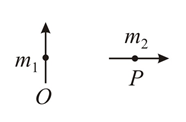
Two short magnetic dipoles $$m_1$$ and $$m_2$$ each having magnetic moment of 1 A m$$^2$$ are placed at point O and P respectively. The distance between OP is 1 m. The torque experienced by the magnetic dipole $$m_2$$ due to the presence of $$m_1$$ is _________ $$\times 10^{-7}$$ N m
Correct Answer: 1
We need to determine the torque experienced by the magnetic dipole $$m_2$$ due to the magnetic field produced by the magnetic dipole $$m_1$$.
From the problem parameters , we have two short magnetic dipoles with the following values:
Based on standard dipole configurations for calculating torque, the dipole $$m_1$$ at point O creates an axial magnetic field at the position of dipole $$m_2$$ at point P, where $$m_2$$ is oriented perpendicular to this field.
The magnetic field produced by a short magnetic dipole at a point on its axial line at distance $$r$$ is given by the formula:
$$B_1 = \frac{\mu_0}{4\pi} \frac{2m_1}{r^3}$$
Substituting the standard value of $$\frac{\mu_0}{4\pi} = 10^{-7}\text{ T m A}^{-1}$$ and the given problem constants:
$$B_1 = 10^{-7} \times \frac{2 \times 1}{(1)^3} = 2 \times 10^{-7}\text{ T}$$
The torque ($$\tau$$) acting on a magnetic dipole placed in a uniform external magnetic field is given by the vector cross product formula:
$$\tau = m_2 \cdot B_1 \cdot \sin(\theta)$$
Since the dipole $$m_2$$ is oriented perpendicular ($$\theta = 90^\circ$$) to the axial magnetic field line produced by $$m_1$$, the value of $$\sin(90^\circ) = 1$$. Substituting these values gives:
$$\tau = 1 \times (2 \times 10^{-7}) \times 1 = 2 \times 10^{-7}\text{ N m}$$
The problem asks for the torque in the expression format of $$\text{Value} \times 10^{-7}\text{ N m}$$:
$$\tau = 2 \times 10^{-7}\text{ N m} \implies \text{Value} = 2$$
The value of the torque experienced by the magnetic dipole is 2.
Was this solution helpful?
Create a FREE account and get:
_1.webp)

Educational materials for JEE preparation

Ask our AI anything

AI can make mistakes. Please verify important information.
AI can make mistakes. Please verify important information.
