
Join Our JEE Preparation Group
Prep with like-minded aspirants; Get access to free daily tests and study material.
Sign in
Please select an account to continue using cracku.in
↓ →
Join Our JEE Preparation Group
Prep with like-minded aspirants; Get access to free daily tests and study material.
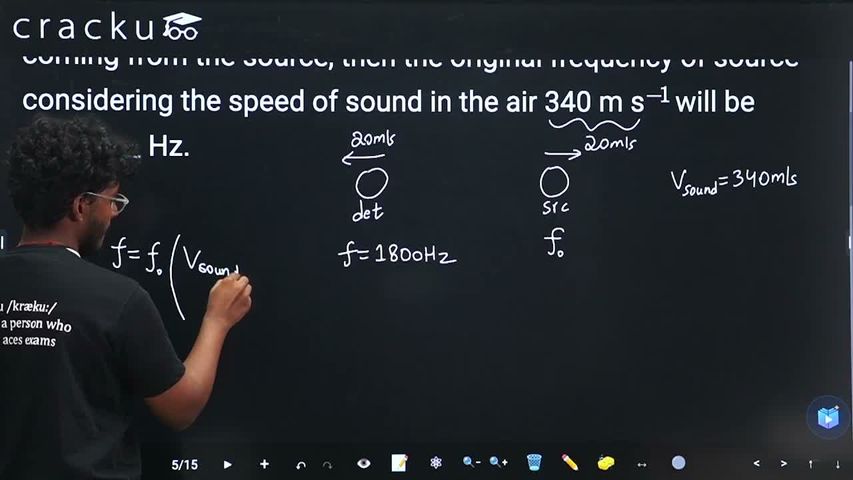
A source and a detector move away from each other in absence of wind with a speed of 20 m s$$^{-1}$$, with respect to the ground. If the detector detects a frequency of 1800 Hz of the sound coming from the source, then the original frequency of source considering the speed of sound in the air 340 m s$$^{-1}$$ will be _________ Hz.
Correct Answer: 2025
For sound waves in still air the Doppler-effect formula relating the actual frequency of the source $$f$$ and the frequency detected by an observer $$f'$$ is stated first:
$$$f' \;=\; f \left( \frac{v - v_{\text{observer}}}{v + v_{\text{source}}} \right)$$$
Here
• $$v$$ is the speed of sound in air.
• $$v_{\text{observer}}$$ is the speed of the observer measured positive when he or she moves towards the source.
• $$v_{\text{source}}$$ is the speed of the source measured positive when it moves away from the observer.
In the present situation both the source and the detector are receding from one another at 20 m s$$^{-1}$$ with respect to the ground. Hence, with the line joining them taken as the reference direction:
$$$v_{\text{observer}} = 20 \text{ m s}^{-1}\quad(\text{away, so it enters the formula with a minus sign}),$$$
$$$v_{\text{source}} = 20 \text{ m s}^{-1}\quad(\text{away, so it is positive in the denominator}).$$$
The speed of sound is given as
$$v = 340 \text{ m s}^{-1}.$$
Substituting these numerical values into the stated formula, we have
$$f' \;=\; f \left( \frac{340 - 20}{340 + 20} \right).$$
Simplifying the bracketed fraction step by step,
$$340 - 20 = 320,$$
$$340 + 20 = 360,$$
so
$$f' = f \left( \frac{320}{360} \right).$$
The detected frequency is given as $$f' = 1800 \text{ Hz}$$. Therefore,
$$1800 = f \left( \frac{320}{360} \right).$$
To isolate $$f$$ we multiply both sides by $$\dfrac{360}{320}$$:
$$f = 1800 \times \frac{360}{320}.$$
Reducing the fraction first,
$$\frac{360}{320} = \frac{36}{32} = \frac{9}{8}.$$
Hence,
$$f = 1800 \times \frac{9}{8}.$$
Calculating the product,
$$f = 1800 \times 1.125 = 2025 \text{ Hz}.$$
So, the original (actual) frequency emitted by the source is $$2025 \text{ Hz}$$.
Hence, the correct answer is Option 2025.
Was this solution helpful?
Click on the Email ☝️ to Watch the Video Solution
Create a FREE account and get:
_1.webp)

Educational materials for JEE preparation

Ask our AI anything

AI can make mistakes. Please verify important information.
AI can make mistakes. Please verify important information.
