
Join Our JEE Preparation Group
Prep with like-minded aspirants; Get access to free daily tests and study material.
Sign in
Please select an account to continue using cracku.in
↓ →
Join Our JEE Preparation Group
Prep with like-minded aspirants; Get access to free daily tests and study material.
Two travelling waves produces a standing wave represented by equation.
$$y = (1.0 \text{ mm}) \cos[(1.57 \text{ cm}^{-1})x] \sin[(78.5 \text{ s}^{-1}) t]$$. The node closest to the origin in the region $$x > 0$$ will be at $$x$$ = _________ (in cm).
Correct Answer: 1
We are given the standing-wave equation
$$y \;=\; (1.0\ \text{mm}) \,\cos[(1.57\ \text{cm}^{-1})\,x]\,\sin[(78.5\ \text{s}^{-1})\,t]$$
In a standard standing wave of the form $$y = A\cos(kx)\sin(\omega t)$$, the factor $$\cos(kx)$$ represents the spatial part of the amplitude. A node is a point that always remains at zero displacement, so its amplitude must be zero for all times $$t$$. Therefore, for a node we must have
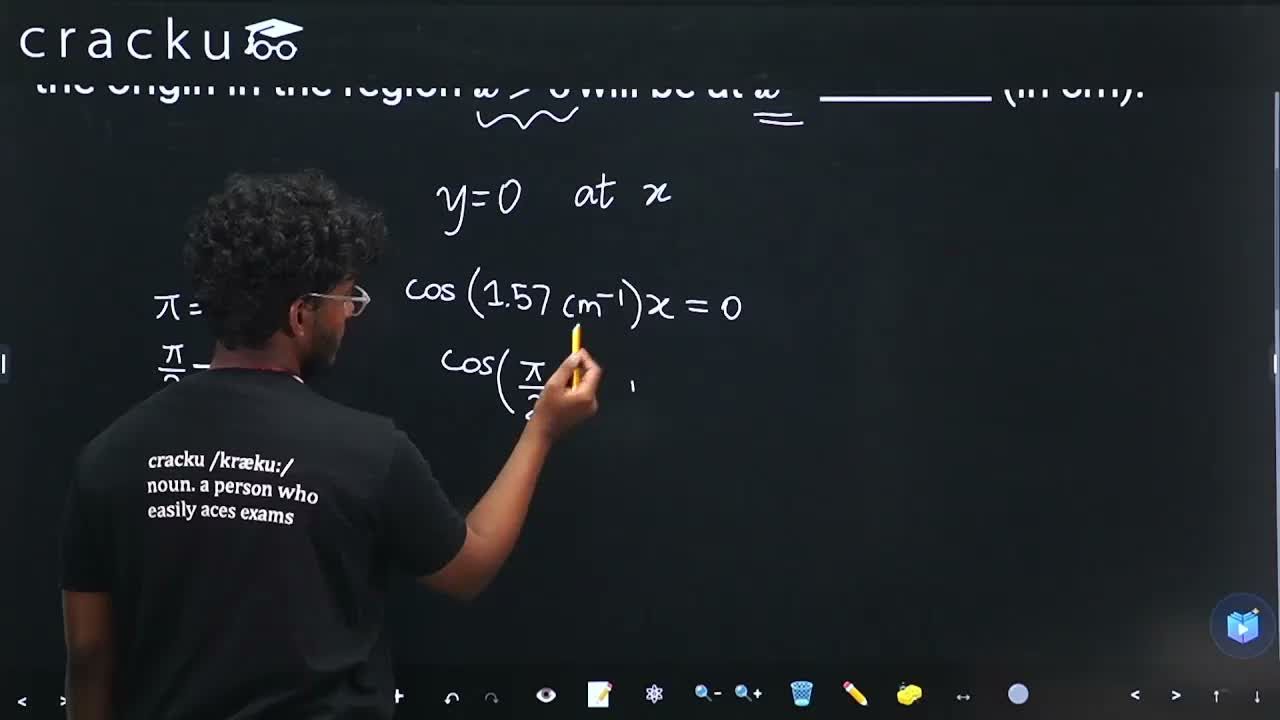
$$\cos(kx)=0.$$
Here the wave number is given by
$$k = 1.57\ \text{cm}^{-1}.$$
We now apply the standard cosine-zero condition. We know the trigonometric fact:
$$\cos\theta = 0 \quad\text{when}\quad \theta = \frac{\pi}{2} + n\pi, \qquad n = 0,1,2,\dots$$
Substituting $$\theta = kx$$, this condition becomes
$$k\,x \;=\; \frac{\pi}{2} + n\pi.$$
Because we want the node closest to the origin in the region $$x > 0$$, we choose the smallest non-negative integer $$n=0$$. So we write
$$k\,x = \frac{\pi}{2}.$$
Now we substitute the numerical value of $$k$$:
$$1.57\ \text{cm}^{-1}\;\; x = \frac{\pi}{2}.$$
To isolate $$x$$, we divide both sides by $$1.57\ \text{cm}^{-1}$$:
$$x = \frac{\dfrac{\pi}{2}}{1.57\ \text{cm}^{-1}}.$$
We next evaluate the numerator. Using $$\pi \approx 3.1416$$, we get
$$\frac{\pi}{2} \approx \frac{3.1416}{2} = 1.5708.$$
So
$$x \approx \frac{1.5708}{1.57}\ \text{cm}.$$
Carrying out the division,
$$x \approx 1.0018\ \text{cm}.$$
We can round this to three significant figures as
$$x \approx 1.00\ \text{cm}.$$
Thus the node that lies closest to the origin for the region $$x > 0$$ is situated at a distance of approximately one centimetre from the origin.
So, the answer is $$1.0\ \text{cm}$$.
Was this solution helpful?
Click on the Email ☝️ to Watch the Video Solution
Create a FREE account and get:
_1.webp)

Educational materials for JEE preparation

Ask our AI anything

AI can make mistakes. Please verify important information.
AI can make mistakes. Please verify important information.
