Sign in
Please select an account to continue using cracku.in
↓ →

Join Our JEE Preparation Group
Prep with like-minded aspirants; Get access to free daily tests and study material.
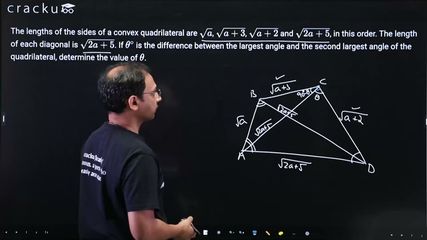
The lengths of the sides of a convex quadrilateral are $$\sqrt{a}$$, $$\sqrt{a + 3}$$, $$\sqrt{a + 2}$$ and $$\sqrt{2a + 5}$$, in this order. The length of each diagonal is $$\sqrt{2a + 5}$$. If $$\theta^\circ$$ is the difference between the largest angle and the second largest angle of the quadrilateral, determine the value of $$\theta$$.
Correct Answer: 30
Label the consecutive vertices $$A, B, C, D$$, so $$BC^2 + CD^2 = (a + 3) + (a + 2) = BD^2$$ and the converse of Pythagoras gives $$\angle BCD = 90^\circ$$. Drawing $$AH \perp CD$$ and $$AK \perp CB$$ and applying Pythagoras leads to $$\frac{(a + 4)^2}{a + 3} + \frac{a + 2}{4} = 2a + 5$$, which simplifies to $$(3a + 10)(a - 1) = 0$$, so $$a = 1$$. Then $$BK = \tfrac{1}{2}$$ and $$AK = \frac{\sqrt{3}}{2}$$ give $$\angle ABK = 60^\circ$$ and hence $$\angle ABC = 120^\circ$$, while the angles at $$A$$ and $$D$$ are acute base angles of isosceles triangles. The two largest angles are $$120^\circ$$ and $$90^\circ$$, so $$\theta = 30$$.
Was this solution helpful?
Click on the Email ☝️ to Watch the Video Solution
Book Free CAT Mentorship
Get personalized CAT strategy from a 99%iler
500+ students mentored
OTP Verification
Enter the 6-digit code sent to your phone
Booking Summary
Enter OTP
Didn't receive the OTP?
_1.webp)

Predict your JEE Main percentile, rank & performance in seconds

Educational materials for JEE preparation

Ask our AI anything

AI can make mistakes. Please verify important information.
AI can make mistakes. Please verify important information.
 91- 6303239042

