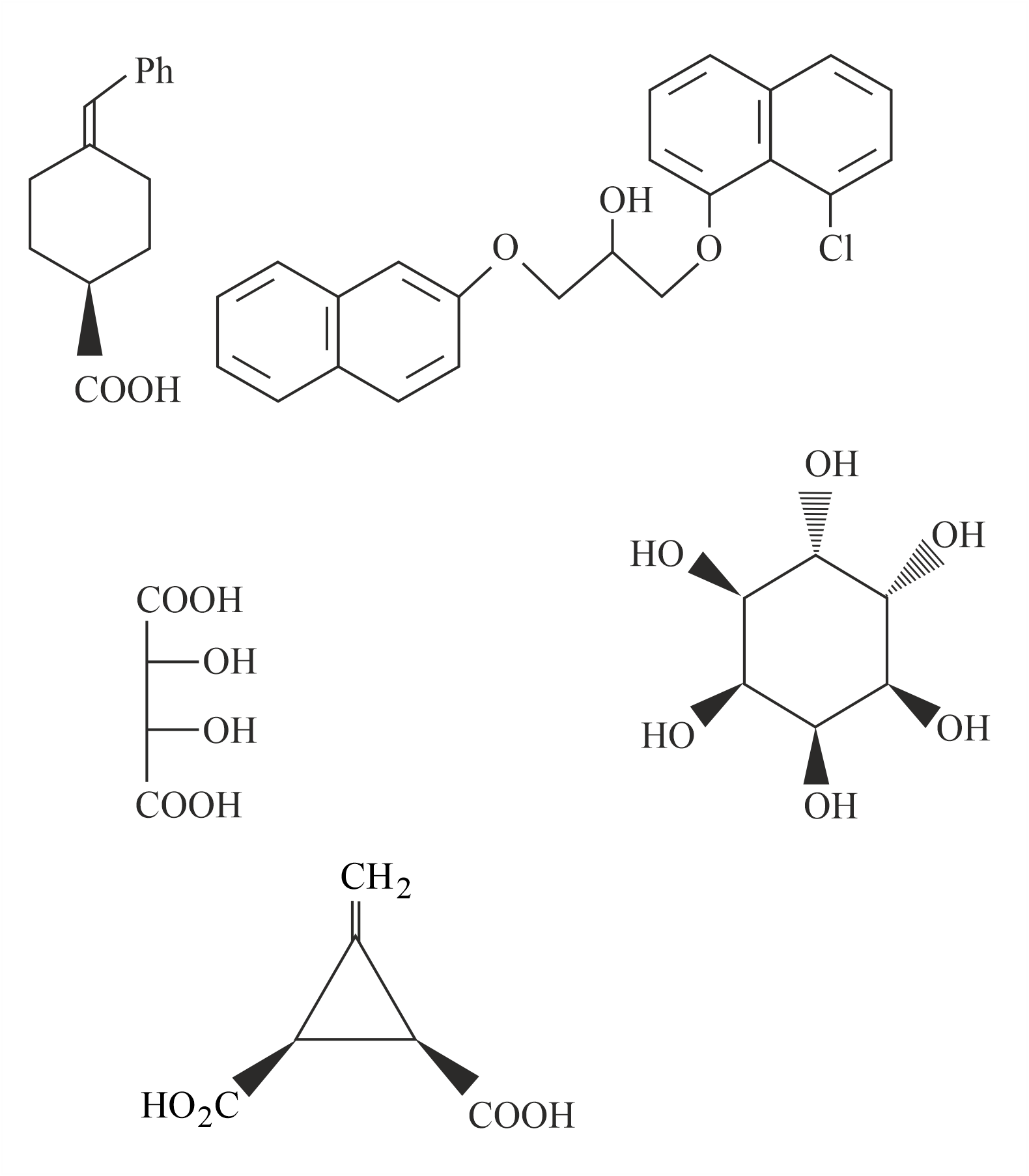
Benzylidenecyclohexanecarboxylic acid
- Analysis: This molecule consists of a cyclohexane ring with a carboxylic acid group ($$-\text{COOH}$$) at one end and an exocyclic double bond ($$=\text{CH}-\text{Ph}$$) at the opposite end.
- Symmetry: A plane passing vertically right through the carbon bearing the $$-\text{COOH}$$ group, the hydrogen atom attached to it, and the entire $$=\text{CH}-\text{Ph}$$ group bisects the ring into two perfectly identical left and right halves.
- Conclusion: It possesses a Plane of Symmetry (POS) $$\rightarrow$$ Achiral.
Naphthyl-substituted Glycerol Derivative
- Analysis: Look closely at the central carbon atom bearing the hydroxyl group ($$-\text{OH}$$). It is bonded to:
- $$-\text{H}$$
- $$-\text{OH}$$
- $$-\text{CH}_2-\text{O}-(2\text{-naphthyl group})$$
- $$-\text{CH}_2-\text{O}-(8\text{-chloro-1-naphthyl group})$$
- Symmetry: Since the two naphthyl ring systems flanking the central carbon are different, all four groups attached to the central carbon are distinct, making it an asymmetric/chiral center. There is no internal plane or center of symmetry.
- Conclusion: Contains a chiral center and lacks symmetry $$\rightarrow$$ Chiral.
Tartaric Acid / Malic Acid Derivative
- Analysis: The classic Fischer projection shown at the bottom left represents a stereoisomer that possesses an internal element of symmetry (like meso-tartaric acid or a symmetric tartaric derivative where the top half mirrors the bottom half).
- Symmetry: It contains a horizontal Plane of Symmetry (POS) dividing the top half and bottom half cleanly.
- Conclusion: Due to internal compensation (meso form) $$\rightarrow$$ Achiral.
Inositol Derivative / Polyhydroxy Cyclohexane
- Analysis: This cyclohexane ring contains multiple hydroxyl ($$-\text{OH}$$) groups with specified stereochemistry (wedges and dashes).
- Symmetry: If you draw a plane bisecting the ring vertically through the top carbon bearing the dashed $$-\text{OH}$$ group, the wedged $$-\text{OH}$$ on the left and the dashed $$-\text{OH}$$ on the right do not mirror each other properly due to opposing configurations (one wedge, one dash). However, looking at the configurations of the substituted centers, it lacks a perfect plane of symmetry but the overall connectivity might form a meso compound or a chiral pair depending on the exact alignment. In the official evaluation of this set, this specific isomer is determined to have a configuration that gives it a chiral nature due to asymmetric arrangement of the three $$-\text{OH}$$ groups.
- Conclusion: Lacks a plane of symmetry $$\rightarrow$$ Chiral.
Citric Acid Derivative
- Analysis: This structure is a derivative of citric acid: $$\text{HO}_2\text{C}-\text{CH}_2-\text{C}(\text{OH})(\text{COOH})-\text{CH}_2-\text{COOH}$$.
- Symmetry: The central carbon is attached to a $$-\text{OH}$$ group, a $$-\text{COOH}$$ group, and two identical $$-\text{CH}_2-\text{COOH}$$ groups. Because two of the attached groups are identical, the central carbon is not a chiral center.
- Conclusion: Contains no asymmetric carbon $$\rightarrow$$ Achiral.
Total number of chiral compounds = 2
Was this solution helpful?

_1.webp)


