For the following questions answer them individually
Given below are two statements: one is labelled as Assertion A and the other is labelled as Reason R
Assertion A: Hydrogen is an environment friendly fuel.
Reason R: Atomic number of hydrogen is 1 and it is a very light element.
In the light of the above statements, choose the correct answer from the options given below
Match List I with List II
(A) Slaked lime  (I) NaOH
(B) Dead burnt plaster  (II) Ca(OH)$$_2$$
(C) Caustic soda  (III) Na$$_2$$CO$$_3$$ $$\cdot$$ 10H$$_2$$O
(D) Washing soda  (IV) CaSO$$_4$$
Choose the correct statement(s):
A. Beryllium oxide is purely acidic in nature.
B. Beryllium carbonate is kept in the atmosphere of CO$$_2$$.
C. Beryllium sulphate is readily soluble in water.
D. Beryllium shows anomalous behavior.
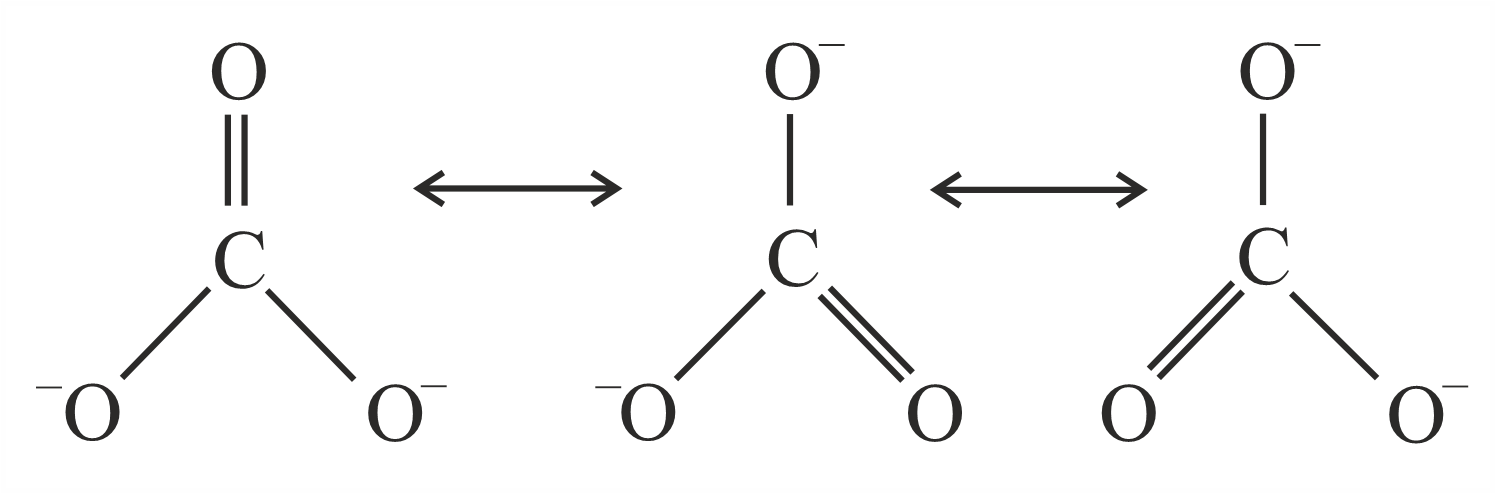
Resonance in carbonate ion CO$$_3^{2-}$$ is

Which of the following is true?
But-2-yne is reacted separately with one mole of Hydrogen as shown below:
B $$\xleftarrow{\text{Na/liq NH}_3}$$ CH$$_3$$-C$$\equiv$$C-CH$$_3$$ $$\xrightarrow[\Delta]{\text{Pd/C, +H}_2}$$ A
Identify the incorrect statements from the options given below:
A. A is more soluble than B.
B. The boiling point & melting point of A are higher and lower than B respectively.
C. A is more polar than B because dipole moment of A is zero.
D. Br$$_2$$ adds easily to B than A.
How can photochemical smog be controlled?
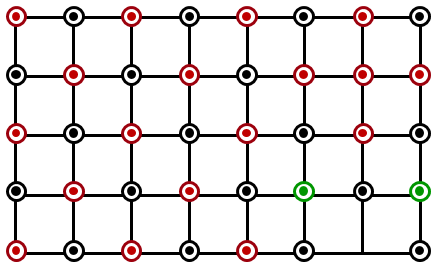
Which of the following represents the lattice structure of A$$_{0.95}$$O containing A$$^{2+}$$, A$$^{3+}$$ and O$$^{2-}$$ ions?

Given below are two statements:
Assertion A: Amongst He, Ne, Ar and Kr; 1 g of activated charcoal adsorbs more of Kr.
Reason R: The critical volume V$$_c$$ (cm$$^3$$ mol$$^{-1}$$) and critical pressure P$$_c$$ (atm) is highest for Krypton but the compressibility factor at critical point Z$$_c$$ is lowest for Krypton.
Given below are two statements:
Assertion A: In an Ellingham diagram, the oxidation of carbon to carbon monoxide shows a negative slope with respect to temperature.
Reason R: CO tends to get decomposed at higher temperature.
Given below are two statements:
Statement I: Chlorine can easily combine with oxygen to from oxides; and the product has a tendency to explode.
Statement II: Chemical reactivity of an element can be determined by its reaction with oxygen and halogens.
A solution of FeCl$$_3$$ when treated with K$$_4$$Fe(CN)$$_6$$ gives a prussian blue precipitate due to the formation of
Highest oxidation state of Mn is exhibited in Mn$$_2$$O$$_7$$. The correct statements about Mn$$_2$$O$$_7$$ are
(A) Mn is tetrahedrally surrounded by oxygen atoms
(B) Mn is octahedrally surrounded by oxygen atoms
(C) Contains Mn-O-Mn bridge
(D) Contains Mn-Mn bond.
Choose the correct answer from the options given below
Which of the following complex will show largest splitting of d-orbitals?
Which of the following are the example of double salt?
(A) FeSO$$_4$$ $$\cdot$$ (NH$$_4$$)$$_2$$SO$$_4$$ $$\cdot$$ 6H$$_2$$O
(B) CuSO$$_4$$ $$\cdot$$ 4NH$$_3$$ $$\cdot$$ H$$_2$$O
(C) K$$_2$$SO$$_4$$ $$\cdot$$ Al$$_2$$(SO$$_4$$)$$_3$$ $$\cdot$$ 24H$$_2$$O
(D) Fe(CN)$$_2$$ $$\cdot$$ 4KCN
Choose the correct answer.
Identify the incorrect option from the following:
Decreasing order of dehydration of the following alcohols is
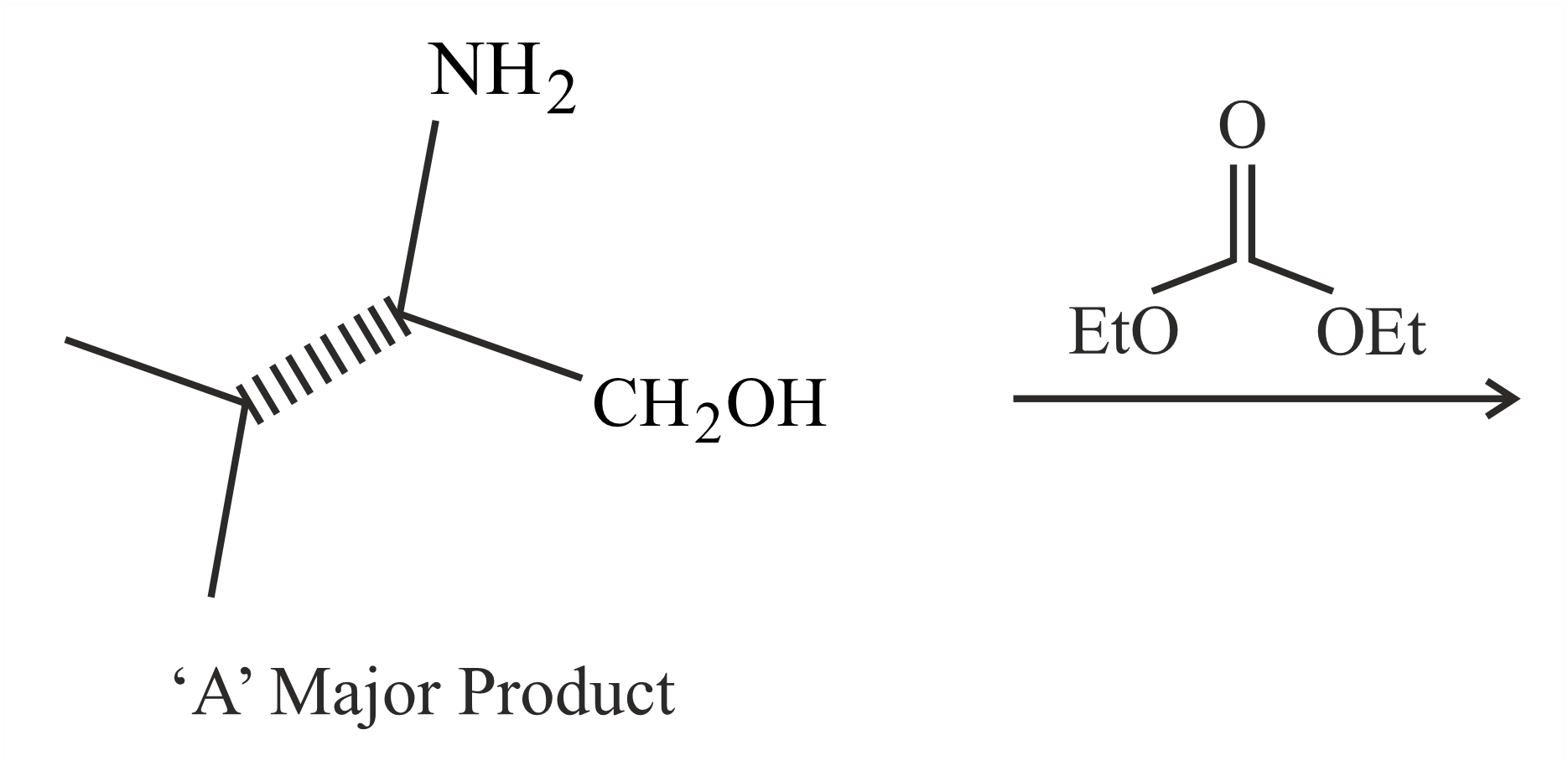
In the following reaction, 'A' is
Match List I with List II
(A) Tranquilizers  (I) Anti blood clotting
(B) Aspirin  (II) Salvarsan
(C) Antibiotic  (III) Antidepressant drugs
(D) Antiseptic  (IV) Soframicine
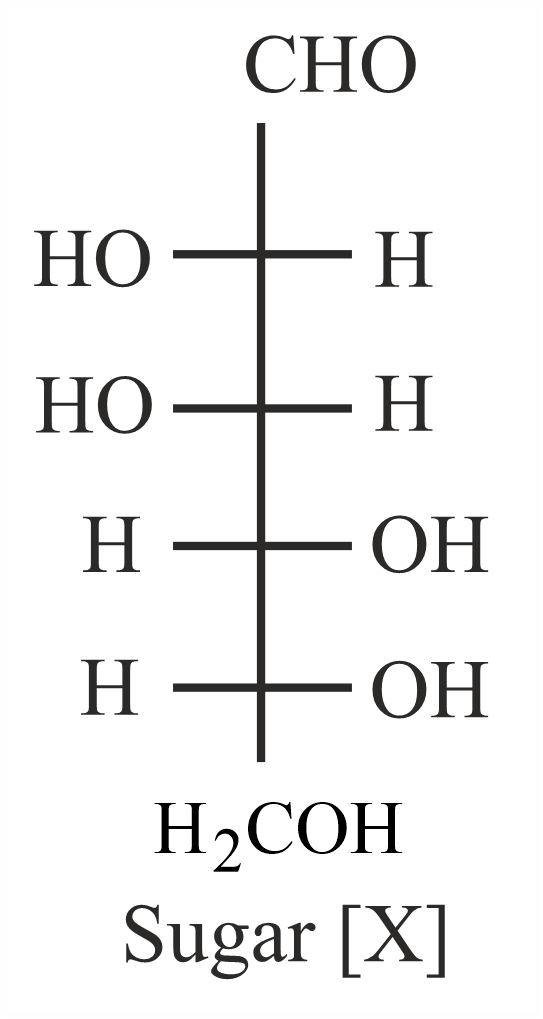
The correct representation in six membered pyranose form for the following sugar [X] is
Match List I and List II
(A) Molisch's Test  (I) Peptide
(B) Biuret Test  (II) Carbohydrate
(C) Carbylamine Test  (III) Primary amine
(D) Schiff's Test  (IV) Aldehyde
The density of 3M solution of NaCl is 1.0 g mL$$^{-1}$$. Molality of the solution is _____ $$\times 10^{-2}$$ m (Nearest integer).
Given: Molar mass of Na is 23 and Cl is 35.5 g mol$$^{-1}$$ respectively.
Electrons in a cathode ray tube have been emitted with a velocity of 1000 ms$$^{-1}$$. The number of following statements which is/are true about the emitted radiation is
Given: h = 6 $$\times$$ 10$$^{-34}$$Js, m$$_e$$ = 9 $$\times$$ 10$$^{-31}$$ kg
(A) The deBroglie wavelength of the electron emitted is 666.67 nm
(B) The characteristic of electrons emitted depend upon the material of the electrodes of the cathode ray tube.
(C) The cathode rays start from cathode and move towards anode.
(D) The nature of the emitted electrons depends on the nature of the gas present in cathode ray tube..
At 25°C, the enthalpy of the following processes are given:
H$$_2$$(g) + O$$_2$$(g) $$\to$$ 2OH(g) $$\Delta$$H$$^0$$ = 78 kJ mol$$^{-1}$$
H$$_2$$(g) + 1/2O$$_2$$(g) $$\to$$ H$$_2$$O(g) $$\Delta$$H$$^0$$ = -242 kJ mol$$^{-1}$$
H$$_2$$(g) $$\to$$ 2H(g) $$\Delta$$H$$^0$$ = 436 kJ mol$$^{-1}$$
1/2O$$_2$$(g) $$\to$$ O(g) $$\Delta$$H$$^0$$ = 249 kJ mol$$^{-1}$$
H$$_2$$O(g) $$\to$$ Hg + OHg $$\Delta$$H$$^0$$ = X kJmol$$^{-1}$$
What would be the value of X for the following reaction? (Nearest integer)
(i) X(g) $$\rightleftharpoons$$ Y(g) + Z(g) K$$_{p1}$$ = 3
(ii) A(g) $$\rightleftharpoons$$ 2B(g) K$$_{p2}$$ = 1
If the degree of dissociation and initial concentration of both the reactants X(g) and A(g) are equal, then the ratio of the total pressure at equilibrium $$\frac{p_1}{p_2}$$ is equal to x : 1. The value of x is (Nearest integer)
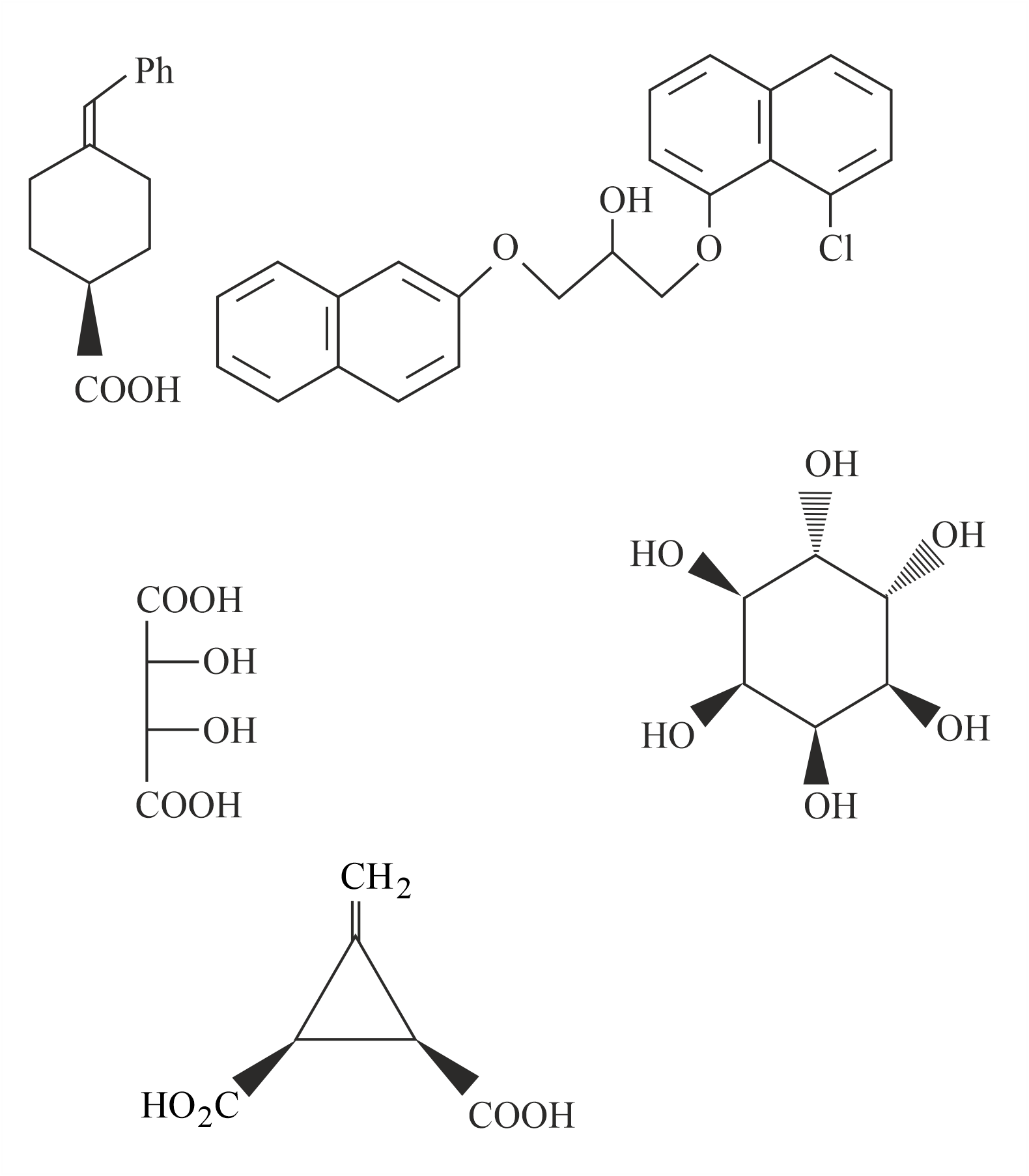
The total number of chiral compound/s from the following is
25 mL of an aqueous solution of KCl was found to require 20 mL of 1M AgNO$$_3$$ solution when titrated using K$$_2$$CrO$$_4$$ as an indicator. What is the depression in freezing point of KCl solution of the given concentration?
(Nearest integer).
(Given: K$$_f$$ = 2.0 K kg mol$$^{-1}$$)
Assume 1) 100% ionization and 2) density of the aqueous solution as 1 g mL$$^{-1}$$
At what pH, given half cell MnO$$_4^-$$(0.1M) | Mn$$^{2+}$$(0.001 M) will have electrode potential of 1.282 V? (Nearest Integer)
Given E$$^0_{MnO_4^-/Mn^{2+}}$$ = 1.54 V, $$\frac{2.303RT}{F}$$ = 0.059 V
A and B are two substances undergoing radioactive decay in a container. The half life of A is 15 min and that of B is 5 min. If the initial concentration of B is 4 times that of A and they both start decaying at the same time, how much time will it take for the concentration of both of them to be same? _____ min.
Sum of oxidation states of bromine in bromic acid and perbromic acid is
Number of isomeric compounds with molecular formula C$$_9$$H$$_{10}$$O which
(i) do not dissolve in NaOH
(ii) do not dissolve in HCl.
(iii) do not give orange precipitate with 2, 4-DNP
(iv) on hydrogenation give identical compound with molecular formula C$$_9$$H$$_{12}$$O is