
Join Our JEE Preparation Group
Prep with like-minded aspirants; Get access to free daily tests and study material.
Sign in
Please select an account to continue using cracku.in
↓ →
Join Our JEE Preparation Group
Prep with like-minded aspirants; Get access to free daily tests and study material.
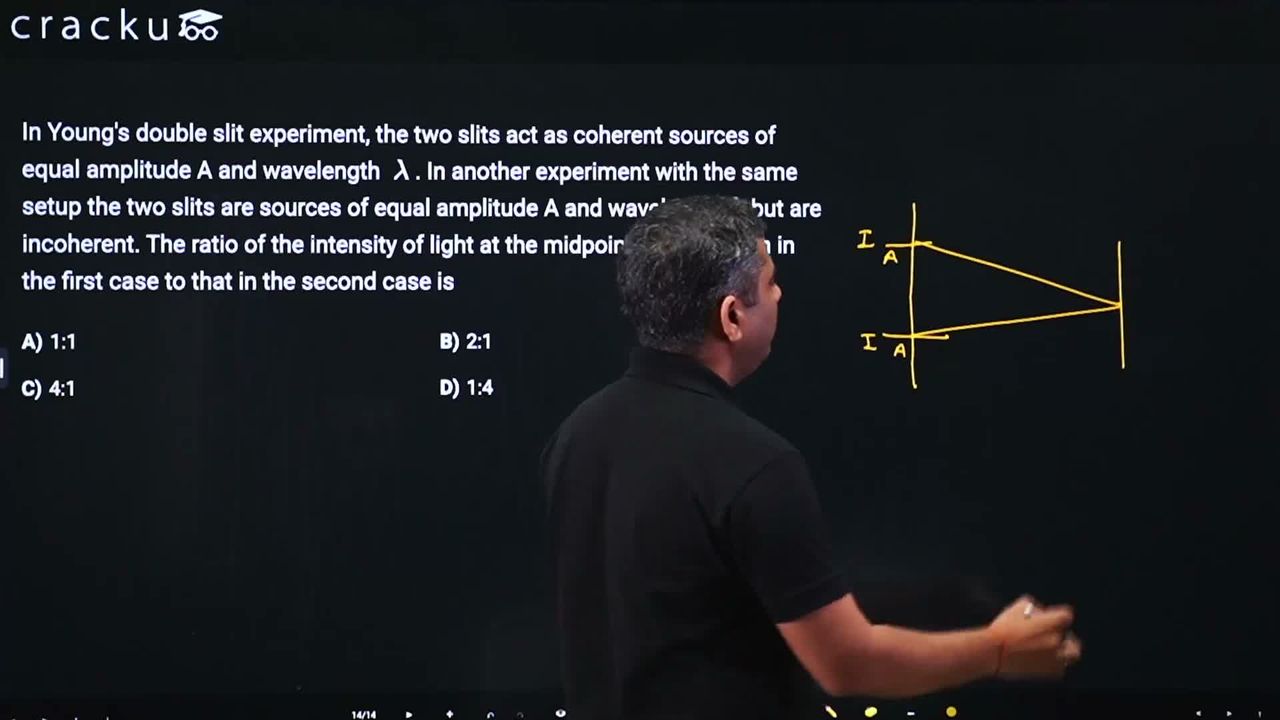
In Young's double slit experiment, the two slits act as coherent sources of equal amplitude A and wavelength $$ \lambda $$ . In another experiment with the same setup the two slits are sources of equal amplitude A and wavelength $$ \lambda $$ but are incoherent. The ratio of the intensity of light at the midpoint of the screen in the first case to that in the second case is
For coherent sources of equal amplitude $$A$$, the resulting amplitude at the midpoint of the screen (where path difference is zero, so phase difference $$\phi = 0$$) is: $$$A_{1} = A + A = 2A$$$ Since intensity is proportional to the square of amplitude ($$I \propto A^2$$): $$$I_1 \propto (2A)^2 = 4A^2$$$ For incoherent sources of equal amplitude $$A$$, the intensities simply add up without interference: $$$I_2 = I_0 + I_0 \propto A^2 + A^2 = 2A^2$$$ Taking the ratio of the intensities in the two cases: $$$\frac{I_1}{I_2} = \frac{4A^2}{2A^2} = 2:1$$$ The ratio of the intensity of light at the midpoint of the screen in the first case to that in the second case is 2:1 (or 2).
Was this solution helpful?
Click on the Email ☝️ to Watch the Video Solution
Create a FREE account and get:


Educational materials for JEE preparation

Ask our AI anything

AI can make mistakes. Please verify important information.
AI can make mistakes. Please verify important information.
