
Join Our JEE Preparation Group
Prep with like-minded aspirants; Get access to free daily tests and study material.
Sign in
Please select an account to continue using cracku.in
↓ →
Join Our JEE Preparation Group
Prep with like-minded aspirants; Get access to free daily tests and study material.
A glass prism of refractive index $$1.5$$ is immersed in water (refractive index $$\frac{4}{3}$$ ) as shown in figure. A light beam incident normally on the face $$AB$$ is totally reflected to reach the face $$BC$$, if
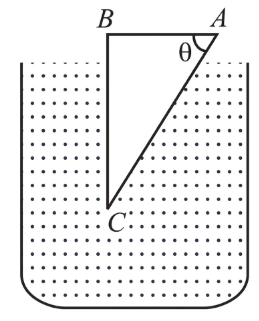
Let us analyze the path of the light beam inside the glass prism immersed in water. We are given:
A light beam is incident normally on the face $$AB$$. Because it strikes perpendicular to the surface ($$\angle i = 0^\circ$$), it passes straight into the prism without any deviation and travels directly toward the inclined face $$AC$$.
Let us determine the angle of incidence ($$i_c$$) at the face $$AC$$ using geometry:
Therefore, the angle of incidence at the glass-water interface on face $$AC$$ is:
$$i = \theta$$
For the light beam to be totally reflected at the face $$AC$$, the angle of incidence must be strictly greater than the critical angle ($$\theta_c$$) for the glass-water boundary:
$$i > \theta_c \implies \theta > \theta_c$$
Taking the sine of both sides preserves the inequality:
$$\sin\theta > \sin\theta_c$$
According to Snell's Law, the sine of the critical angle when traveling from a denser medium (glass) to a rarer medium (water) is given by the ratio of their refractive indices:
$$\sin\theta_c = \frac{\mu_{\text{rarer}}}{\mu_{\text{denser}}} = \frac{\mu_w}{\mu_g}$$
Substitute the given numerical values of the refractive indices:
$$\sin\theta_c = \frac{\frac{4}{3}}{\frac{3}{2}} = \frac{4}{3} \times \frac{2}{3} = \frac{8}{9}$$
Substituting this back into our total internal reflection condition inequality gives:
$$\sin\theta > \frac{8}{9}$$
Correct Option Key: Option C ($$\sin\theta > \frac{8}{9}$$)
Was this solution helpful?
Create a FREE account and get:
_1.webp)

Educational materials for JEE preparation

Ask our AI anything

AI can make mistakes. Please verify important information.
AI can make mistakes. Please verify important information.
