Sign in
Please select an account to continue using cracku.in
↓ →

Join Our JEE Preparation Group
Prep with like-minded aspirants; Get access to free daily tests and study material.
Let $$P$$ be a point in the interior of a triangle $$ABC$$ and let $$AP, BP, CP$$ meet the sides $$BC, CA, AB$$ in $$D, E, F$$ respectively. If $$ \frac{BP}{PE}=\frac{5}{2}, \frac{CP}{PF}=\frac{7}{3},$$ and $$ \frac{AP}{PD}=\frac{p}{q}, $$ where $$p$$ and $$q$$ are natural numbers and $$gcd(𝑝, 𝑞) = 1$$, find $$𝑝 + 𝑞$$.
Correct Answer: 70
Assign masses $$m_A , m_B , m_C$$ to the vertices $$A , B , C$$ respectively and use the Mass-Points rule:
If a point $$P$$ lies on the segment joining two points with masses $$m_1 , m_2$$, then
$$\dfrac{\text{distance from }P\text{ to point with mass }m_1}{\text{distance from }P\text{ to point with mass }m_2}= \dfrac{m_2}{m_1}$$.
1. Along $$B \!-\! P \!-\! E$$ we have $$\dfrac{BP}{PE}= \dfrac{5}{2}$$.
Mass at $$B$$ is $$m_B$$, mass at $$E$$ is the sum of the endpoint masses on $$CA$$, i.e. $$m_E = m_A + m_C$$.
Therefore $$\dfrac{m_E}{m_B}= \dfrac{5}{2}\;\; \Rightarrow\;\; m_A + m_C = \tfrac{5}{2}\,m_B$$. $$(1)$$
2. Along $$C \!-\! P \!-\! F$$ we have $$\dfrac{CP}{PF}= \dfrac{7}{3}$$.
Mass at $$C$$ is $$m_C$$, mass at $$F$$ is the sum on $$AB$$, i.e. $$m_F = m_A + m_B$$.
Therefore $$\dfrac{m_F}{m_C}= \dfrac{7}{3}\;\; \Rightarrow\;\; m_A + m_B = \tfrac{7}{3}\,m_C$$. $$(2)$$
Choose $$m_B = 2t$$ so that equation $$(1)$$ becomes $$m_A + m_C = 5t$$.
Put $$m_C = c$$. Then $$m_A = 5t - c$$ and substitute these in $$(2)$$:
$$(5t - c) + 2t = \tfrac{7}{3}\,c \;\; \Rightarrow\;\; 7t - c = \tfrac{7}{3}\,c$$
$$\Rightarrow\; 7t = \tfrac{10}{3}\,c \;\; \Rightarrow\;\; c = \tfrac{21}{10}\,t.$$
Hence $$m_A = 5t - \tfrac{21}{10}t = \tfrac{29}{10}t,\qquad m_B = 2t = \tfrac{20}{10}t,\qquad m_C = \tfrac{21}{10}t.$$
Multiply by $$10$$ to clear the denominator and obtain integral masses:
$$m_A : m_B : m_C = 29t : 20t : 21t.$$
The common factor $$t$$ is irrelevant, so take
$$m_A = 29,\; m_B = 20,\; m_C = 21.$$
3. Point $$D$$ lies on $$BC$$, hence its mass is the sum of the masses at $$B$$ and $$C$$:
$$m_D = m_B + m_C = 20 + 21 = 41.$$
Along $$A \!-\! P \!-\! D$$ we therefore have
$$\dfrac{AP}{PD}= \dfrac{m_D}{m_A}= \dfrac{41}{29}.$$
Thus $$\dfrac{AP}{PD}= \dfrac{p}{q}= \dfrac{41}{29} \; \Rightarrow\; (p,q)=(41,29).$$
Since $$\gcd(41,29)=1$$, we get $$p+q = 41 + 29 = 70.$$
Answer: 70
Was this solution helpful?
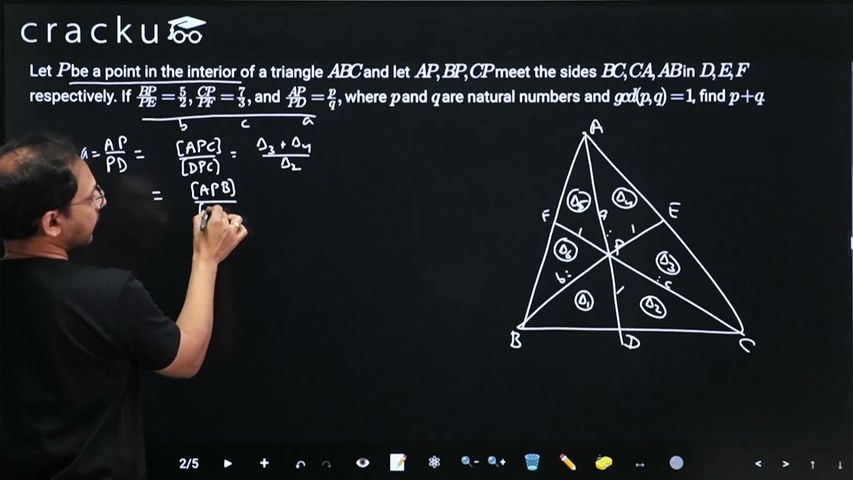
Click on the Email ☝️ to Watch the Video Solution
Book Free CAT Mentorship
Get personalized CAT strategy from a 99%iler
500+ students mentored
OTP Verification
Enter the 6-digit code sent to your phone
Booking Summary
Enter OTP
Didn't receive the OTP?
_1.webp)

Predict your JEE Main percentile, rank & performance in seconds

Educational materials for JEE preparation

Ask our AI anything

AI can make mistakes. Please verify important information.
AI can make mistakes. Please verify important information.
 91- 6303239042

