
Join Our JEE Preparation Group
Prep with like-minded aspirants; Get access to free daily tests and study material.
Sign in
Please select an account to continue using cracku.in
↓ →
Join Our JEE Preparation Group
Prep with like-minded aspirants; Get access to free daily tests and study material.
Consider a configuration of $$n$$ identical units, each consisting of three layers. The first layer is a column of air of height $$h = \dfrac{1}{3}$$ cm, and the second and third layers are of equal thickness $$d = \dfrac{\sqrt{3}-1}{2}$$ cm, and refractive indices $$\mu_1 = \dfrac{\sqrt{3}}{2}$$ and $$\mu_2 = \sqrt{3}$$, respectively. A light source O is placed on the top of the first unit as shown in the figure. A Ray of light from $$O$$ is incident on the second layer of the first unit at an angle of $$\theta = 60^\circ$$ to the normal. For a specific value of $$n$$, the ray of light emerges from the bottom of the configuration at a distance $$l = \dfrac{8}{\sqrt{3}}$$ cm, as shown in the figure. The value of $$n$$ is _______.
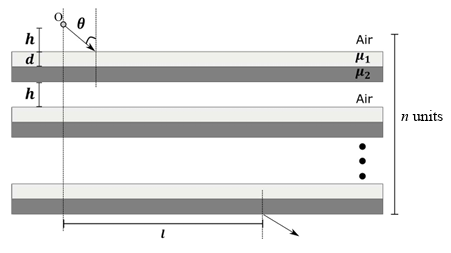
Correct Answer: 4
Using Snell's law at successive parallel interfaces starting from air ($$\mu_0 = 1$$) at angle $$\theta = 60^\circ$$:
$$\mu_0 \sin\theta = \mu_1 \sin r_1 = \mu_2 \sin r_2 = \mu_{\text{air}} \sin r_{\text{air}}$$
$$\tan r_1 = 1 \implies r_1 = 45^\circ$$
$$\sin r_2 = \frac{1 \cdot \sin 60^\circ}{\sqrt{3}} = \frac{1}{2} \implies r_2 = 30^\circ$$
$$\sin r_{\text{air}} = \sin 60^\circ \implies r_{\text{air}} = 60^\circ$$
$$\Delta x_{\text{unit}} = h \tan r_{\text{air}} + d \tan r_1 + d \tan r_2$$
$$\Delta x_{\text{unit}} = \frac{1}{3}\sqrt{3} + \left(\frac{\sqrt{3}-1}{2}\right)(1) + \left(\frac{\sqrt{3}-1}{2}\right)\left(\frac{1}{\sqrt{3}}\right)$$
$$\Delta x_{\text{unit}} = \frac{1}{\sqrt{3}} + \left(\frac{\sqrt{3}-1}{2}\right)\left(1 + \frac{1}{\sqrt{3}}\right) = \frac{1}{\sqrt{3}} + \left(\frac{\sqrt{3}-1}{2}\right)\left(\frac{\sqrt{3}+1}{\sqrt{3}}\right)$$
$$\Delta x_{\text{unit}} = \frac{1}{\sqrt{3}} + \frac{3-1}{2\sqrt{3}} = \frac{1}{\sqrt{3}} + \frac{1}{\sqrt{3}} = \frac{2}{\sqrt{3}}\text{ cm}$$
$$l = n \cdot \Delta x_{\text{unit}}$$
$$\frac{8}{\sqrt{3}} = n \cdot \frac{2}{\sqrt{3}} \implies n = 4$$
Was this solution helpful?
Create a FREE account and get:
_1.webp)

Educational materials for JEE preparation

Ask our AI anything

AI can make mistakes. Please verify important information.
AI can make mistakes. Please verify important information.
