
Join Our JEE Preparation Group
Prep with like-minded aspirants; Get access to free daily tests and study material.
Sign in
Please select an account to continue using cracku.in
↓ →
Join Our JEE Preparation Group
Prep with like-minded aspirants; Get access to free daily tests and study material.
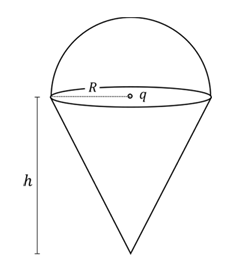
A charge $$q$$ is surrounded by a closed surface consisting of an inverted cone of height $$h$$ and base radius $$R$$, and a hemisphere of radius $$R$$ as shown in the figure. The electric flux through the conical surface is $$\dfrac{nq}{6\epsilon_0}$$ (in SI units). The value of $$n$$ is _______.
Correct Answer: 3
Gauss law states that the total electric flux $$\Phi_{\text{total}}$$ emerging out of any closed surface that encloses a point charge $$q$$ is
$$\Phi_{\text{total}}=\dfrac{q}{\epsilon_0}\,.$$
The given closed surface has two parts.
• Curved surface of a hemisphere of radius $$R$$.
• Curved surface of an inverted cone whose base circle (radius $$R$$) coincides with the rim of the hemisphere.
The point charge $$q$$ is at the common centre of the hemisphere, i.e. at the centre of the complete sphere of radius $$R$$. (This is implied because the hemisphere is specified only by its radius.)
Flux through the hemispherical surface
Because the charge is at the centre of the full sphere of radius $$R$$, the electric field on the spherical surface is radial and of equal magnitude at every point. Hence the flux through the entire sphere would be $$q/\epsilon_0$$. The hemisphere is exactly half of this sphere, so its share of flux is
$$\Phi_{\text{hemisphere}}=\dfrac{1}{2}\left(\dfrac{q}{\epsilon_0}\right)=\dfrac{q}{2\epsilon_0}\,.$$
Flux through the conical surface
Let $$\Phi_{\text{cone}}$$ be the flux through the curved surface of the inverted cone. The hemisphere and the cone together form a closed surface, so
$$\Phi_{\text{hemisphere}}+\Phi_{\text{cone}}=\dfrac{q}{\epsilon_0}\,.$$
Substituting $$\Phi_{\text{hemisphere}}=\dfrac{q}{2\epsilon_0}$$,
$$\dfrac{q}{2\epsilon_0}+\Phi_{\text{cone}}=\dfrac{q}{\epsilon_0}$$
$$\Rightarrow\;\Phi_{\text{cone}}=\dfrac{q}{\epsilon_0}-\dfrac{q}{2\epsilon_0}=\dfrac{q}{2\epsilon_0}\,.$$
The question states that this flux equals $$\dfrac{nq}{6\epsilon_0}$$, so
$$\dfrac{nq}{6\epsilon_0}=\dfrac{q}{2\epsilon_0}\; \Longrightarrow\; n=3.$$
Therefore, the required value of $$n$$ is 3.
Was this solution helpful?
Create a FREE account and get:
_1.webp)

Educational materials for JEE preparation

Ask our AI anything

AI can make mistakes. Please verify important information.
AI can make mistakes. Please verify important information.
