
Join Our JEE Preparation Group
Prep with like-minded aspirants; Get access to free daily tests and study material.
Sign in
Please select an account to continue using cracku.in
↓ →
Join Our JEE Preparation Group
Prep with like-minded aspirants; Get access to free daily tests and study material.
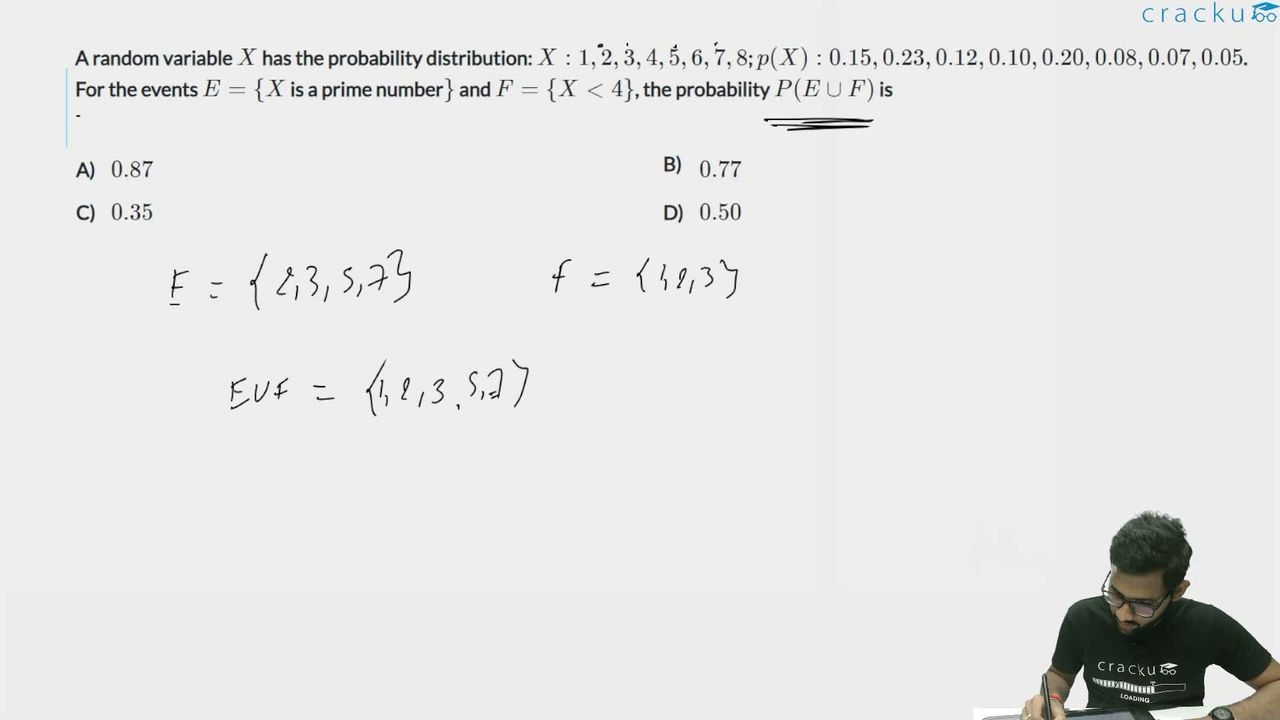
A random variable $$X$$ has the probability distribution: $$X: 1, 2, 3, 4, 5, 6, 7, 8$$; $$p(X): 0.15, 0.23, 0.12, 0.10, 0.20, 0.08, 0.07, 0.05$$. For the events $$E = \{X$$ is a prime number$$\}$$ and $$F = \{X < 4\}$$, the probability $$P(E \cup F)$$ is
We are given the probability distribution for a random variable $$ X $$:
$$ X = 1 \implies P(1) = 0.15 $$
$$ X = 2 \implies P(2) = 0.23 $$
$$ X = 3 \implies P(3) = 0.12 $$
$$ X = 4 \implies P(4) = 0.10 $$
$$ X = 5 \implies P(5) = 0.20 $$
$$ X = 6 \implies P(6) = 0.08 $$
$$ X = 7 \implies P(7) = 0.07 $$
$$ X = 8 \implies P(8) = 0.05 $$
Step 1: Identify the Outcomes for Event $$ E $$
Event $$ E $$ consists of outcomes where $$ X $$ is a prime number. The prime numbers in the given set are 2, 3, 5, and 7:
$$ E = \{2, 3, 5, 7\} $$
Step 2: Identify the Outcomes for Event $$ F $$
Event $$ F $$ consists of outcomes where $$ X < 4 $$:
$$ F = \{1, 2, 3\} $$
Step 3: Find the Union of Events $$ E $$ and $$ F $$
The event $$ E \cup F $$ includes all unique outcomes belonging to either $$ E $$, $$ F $$, or both:
$$ E \cup F = \{1, 2, 3, 5, 7\} $$
Step 4: Calculate the Combined Probability
To find $$ P(E \cup F) $$, we add up the individual probabilities of each outcome in the union:
$$ P(E \cup F) = P(1) + P(2) + P(3) + P(5) + P(7) $$
$$ P(E \cup F) = 0.15 + 0.23 + 0.12 + 0.20 + 0.07 $$
$$ P(E \cup F) = 0.77 $$
Therefore, the probability $$ P(E \cup F) $$ is $$ 0.77 $$.
Was this solution helpful?
Click on the Email ☝️ to Watch the Video Solution
Create a FREE account and get:
_1.webp)

Educational materials for JEE preparation

Ask our AI anything

AI can make mistakes. Please verify important information.
AI can make mistakes. Please verify important information.
