
Join Our JEE Preparation Group
Prep with like-minded aspirants; Get access to free daily tests and study material.
Sign in
Please select an account to continue using cracku.in
↓ →
Join Our JEE Preparation Group
Prep with like-minded aspirants; Get access to free daily tests and study material.
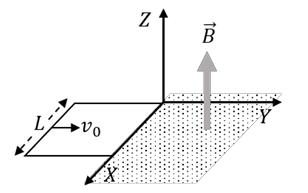
A conducting square loop of side $$L$$, mass $$M$$ and resistance $$R$$ is moving in the $$XY$$ plane with its edges parallel to the $$X$$ and $$Y$$ axes. The region $$y \geq 0$$ has a uniform magnetic field, $$\vec{B} = B_0\hat{k}$$. The magnetic field is zero everywhere else. At time $$t = 0$$, the loop starts to enter the magnetic field with an initial velocity $$v_0 \hat{j}$$ m/s, as shown in the figure. Considering the quantity $$K = \frac{B_0^2 L^2}{RM}$$ in appropriate units, ignoring self-inductance of the loop and gravity, which of the following statements is/are correct:
$$K = \frac{B_0^2 L^2}{RM}$$
Let $$y$$ be the distance the loop has entered the magnetic field at time $$t$$:
$$\Phi = B_0 L y \implies \varepsilon = -\frac{d\Phi}{dt} = -B_0 L v$$
$$i = \frac{B_0 L v}{R}$$
Retardation force acting on the loop:
$$F = -i L B_0 = -\frac{B_0^2 L^2 v}{R}$$
$$M \frac{dv}{dt} = -\frac{B_0^2 L^2}{R}v \implies \frac{dv}{dt} = -K v$$
Integrating with respect to time $$t$$:
$$\int_{v_0}^{v} \frac{dv}{v} = -K \int_{0}^{t} dt \implies v(t) = v_0 e^{-Kt}$$
Integrating with respect to position $$y$$:
$$v \frac{dv}{dy} = -K v \implies \frac{dv}{dy} = -K \implies \int_{v_0}^{v} dv = -K \int_{0}^{y} dy$$
$$v - v_0 = -K y \implies y = \frac{v_0 - v}{K}$$
Evaluating condition for the loop to stop ($$v=0$$): $$y_{\max} = \frac{v_0}{K}$$
For Option (A):
$$v_0 = 1.5KL \implies y_{\max} = \frac{1.5KL}{K} = 1.5L > L \quad (\text{enters completely, Option A is incorrect})$$
For Option (B):
$$\text{When completely inside, } \Phi = \text{constant} \implies \varepsilon = 0 \implies F_{\text{net}} = 0 \quad (\text{Option B is correct})$$
For Option (C):
$$v_0 = \frac{KL}{10} \implies y_{\max} = \frac{KL/10}{K} = 0.1L < L \quad (\text{stops before complete entry})$$
$$v(t) = 0 \implies v_0 e^{-Kt} = 0 \implies t \to \infty \quad (\text{Option C is incorrect})$$
For Option (D):
$$v_0 = 3KL \quad \text{At complete entry } y = L:$$
$$L = \frac{3KL - v}{K} \implies KL = 3KL - v \implies v = 2KL$$
$$v(t) = v_0 e^{-Kt} \implies 2KL = 3KL e^{-Kt} \implies e^{-Kt} = \frac{2}{3}$$
$$t = \frac{1}{K}\ln\left(\frac{3}{2}\right) \quad (\text{Option D is correct})$$
Create a FREE account and get:
_1.webp)

Educational materials for JEE preparation

Ask our AI anything

AI can make mistakes. Please verify important information.
AI can make mistakes. Please verify important information.


