
Join Our JEE Preparation Group
Prep with like-minded aspirants; Get access to free daily tests and study material.
Sign in
Please select an account to continue using cracku.in
↓ →
Join Our JEE Preparation Group
Prep with like-minded aspirants; Get access to free daily tests and study material.
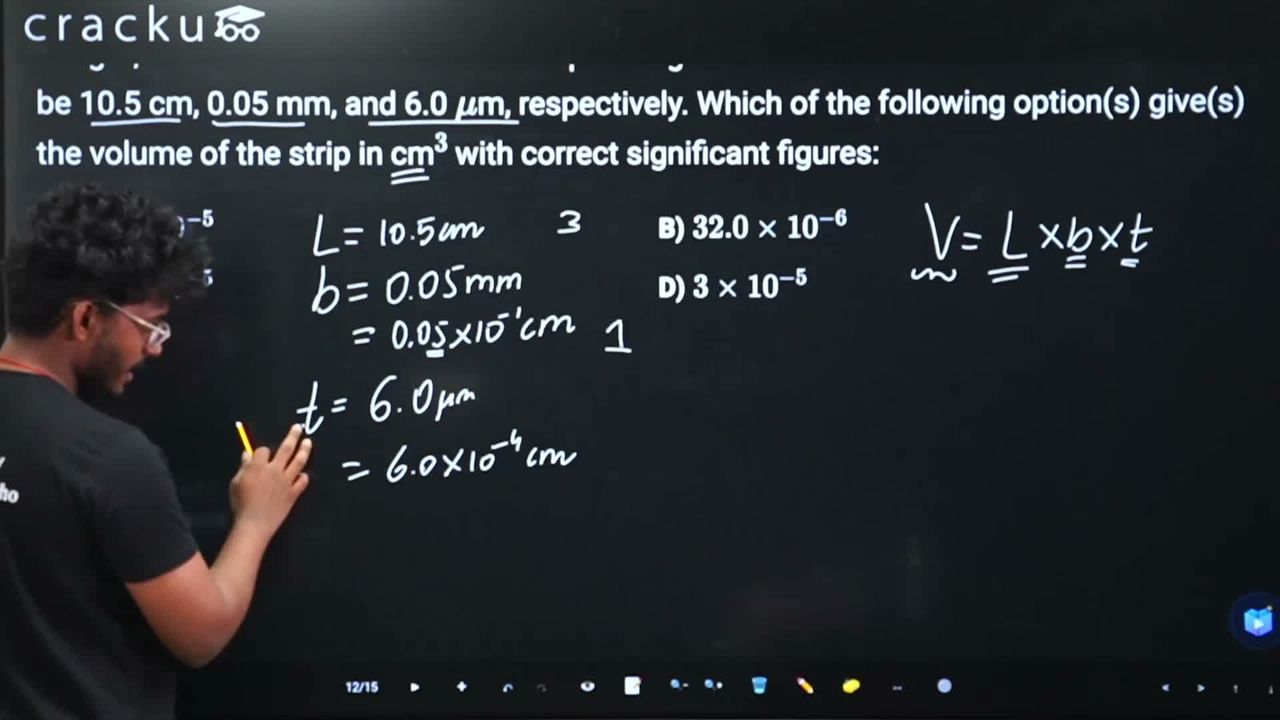
Length, breadth and thickness of a strip having a uniform cross section are measured to be 10.5 cm, 0.05 mm, and 6.0 $$\mu$$m, respectively. Which of the following option(s) give(s) the volume of the strip in cm$$^3$$ with correct significant figures:
First convert every dimension to centimetre (cm) so that the units are consistent:
Length: already $$10.5 \text{ cm}$$ (three significant figures).
Breadth: $$0.05 \text{ mm} = 0.05 \times 0.1 \text{ cm} = 0.005 \text{ cm}$$.
Only the digit 5 is significant here, so breadth has one significant figure.
Thickness: $$6.0 \text{ }\mu\text{m} = 6.0 \times 10^{-4} \text{ cm}$$ (two significant figures).
Volume of the strip is the product of the three dimensions:
$$V = 10.5 \times 0.005 \times 6.0 \times 10^{-4} \text{ cm}^3$$
Step-wise multiplication:
$$10.5 \times 0.005 = 0.0525$$
$$0.0525 \times 6.0 = 0.315$$
$$0.315 \times 10^{-4} = 3.15 \times 10^{-5} \text{ cm}^3$$
In multiplication, the result must carry the same number of significant figures as the factor with the fewest significant figures. Here the breadth (0.05 mm → 0.005 cm) has just 1 significant figure. Therefore the volume must be rounded to one significant figure:
$$3.15 \times 10^{-5} \;\text{cm}^3 \;\longrightarrow\; 3 \times 10^{-5} \;\text{cm}^3$$
Hence the volume, expressed with the correct number of significant figures, is:
Option D which is: $$3 \times 10^{-5}$$
Click on the Email ☝️ to Watch the Video Solution
Create a FREE account and get:
_1.webp)

Educational materials for JEE preparation

Ask our AI anything

AI can make mistakes. Please verify important information.
AI can make mistakes. Please verify important information.


