Sign in
Please select an account to continue using cracku.in
↓ →

Join Our JEE Preparation Group
Prep with like-minded aspirants; Get access to free daily tests and study material.
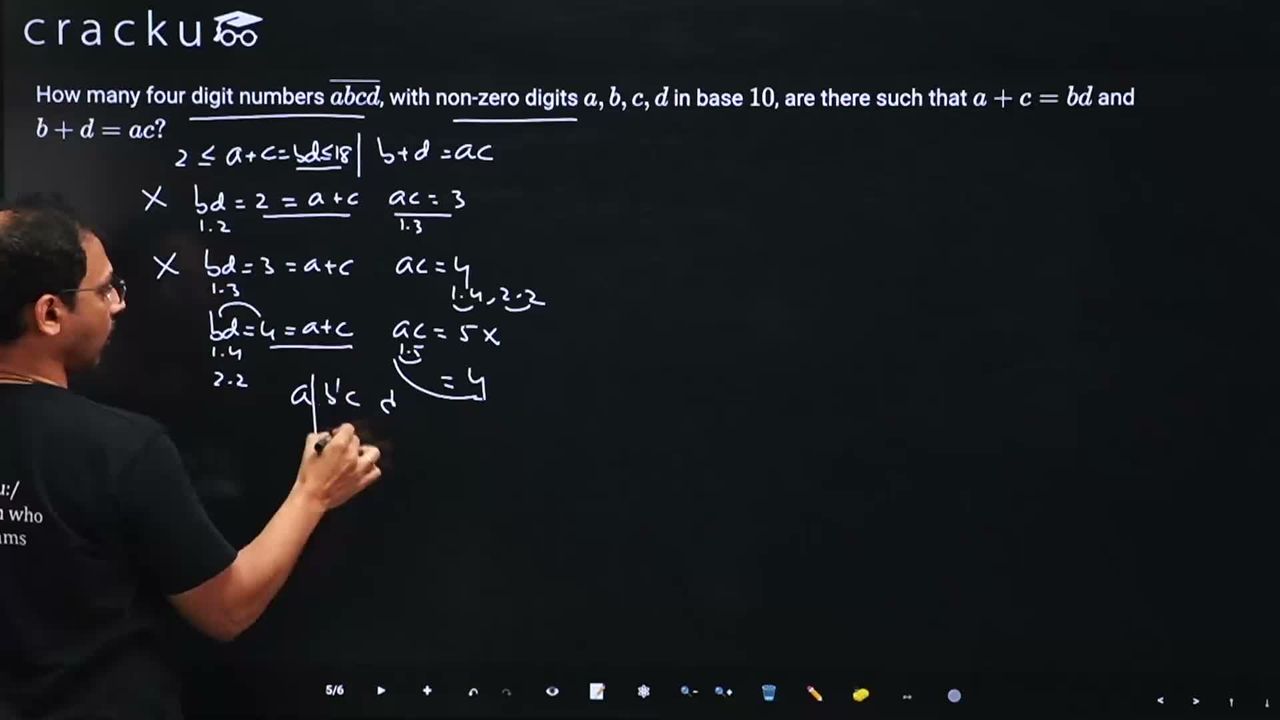
How many four digit numbers $$\overline{abcd}$$, with non-zero digits $$𝑎, 𝑏, 𝑐, 𝑑$$ in base $$10$$, are there such that $$𝑎 + 𝑐 = 𝑏𝑑$$ and $$𝑏 + 𝑑 = 𝑎𝑐?$$
Correct Answer: 09
Let the required four-digit number be $$\overline{abcd}$$, where the digits $$a,b,c,d$$ take values from $$\{1,2,\dots ,9\}$$ (zero is not allowed).
The given conditions are
$$a+c = bd \qquad -(1)$$
$$b+d = ac \qquad -(2)$$
Because every digit is at most $$9$$, the largest possible value of the left-hand sides (the sums) is $$9+9 = 18$$. Hence from $$-(1)$$ and $$-(2)$$ we immediately get
$$bd \le 18, \qquad ac \le 18 \qquad -(3)$$
Thus only those ordered pairs of digits whose product does not exceed $$18$$ can appear in the pairs $$(b,d)$$ and $$(a,c)$$. This already eliminates the large majority of possibilities.
Fix an ordered pair $$(a,c)$$ that satisfies $$ac \le 18$$. Define
$$S_1 = a+c, \qquad S_2 = ac$$
Equations $$-(1)$$ and $$-(2)$$ can now be read as
$$bd = S_1, \qquad b+d = S_2$$
If we regard $$b$$ and $$d$$ as the two roots of a quadratic, they must satisfy
$$t^{2}-S_2\,t+S_1 = 0 \qquad -(4)$$
For $$b,d$$ to be (positive) integral digits, the quadratic in $$-(4)$$ must have
1. A non-negative discriminant: $$\Delta = S_2^{2}-4S_1 \ge 0$$.
2. A perfect-square discriminant (so that the roots are integral).
3. Both roots lying between $$1$$ and $$9$$ (inclusive).
We now list all ordered pairs $$(a,c)$$ with $$ac \le 18$$ and test them with the above three criteria. Because the list is short, the check can be done by hand in a few minutes; the successful pairs are summarised below.
Case 1: $$(a,c)=(1,5)$$No other ordered pair $$(a,c)$$ with $$ac \le 18$$ satisfies the discriminant and root conditions; hence the list above is complete.
Collecting all the valid four-digit numbers:
$$\{\,1253,1352,2135,2222,2531,3125,3521,5213,5312\,\}$$
The count of such numbers is $$9$$.
Answer: 09
Was this solution helpful?
Click on the Email ☝️ to Watch the Video Solution
Book Free CAT Mentorship
Get personalized CAT strategy from a 99%iler
500+ students mentored
OTP Verification
Enter the 6-digit code sent to your phone
Booking Summary
Enter OTP
Didn't receive the OTP?
_1.webp)

Predict your JEE Main percentile, rank & performance in seconds

Educational materials for JEE preparation

Ask our AI anything

AI can make mistakes. Please verify important information.
AI can make mistakes. Please verify important information.
 91- 6303239042

