Sign in
Please select an account to continue using cracku.in
↓ →
 CAT WhatsApp Group
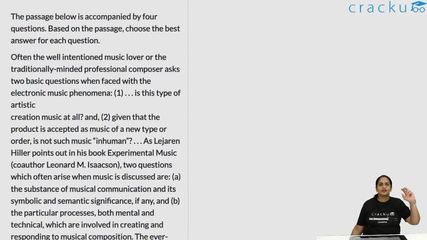
The passage below is accompanied by four questions. Based on the passage, choose the best answer for each question.
Often the well intentioned music lover or the traditionally-minded professional composer asks two basic questions when faced with the electronic music phenomena: (1) . . . is this type of artistic
creation music at all? and, (2) given that the product is accepted as music of a new type or order, is not such music “inhuman”? . . . As Lejaren Hiller points out in his book Experimental Music (coauthor Leonard M. Isaacson), two questions which often arise when music is discussed are: (a) the substance of musical communication and its symbolic and semantic significance, if any, and (b) the particular processes, both mental and technical, which are involved in creating and responding to musical composition. The ever-present popular concept of music as a direct, open, emotional expression and as a subjective form of communication from the composer, is, of course still that of the nineteenth century, when composers themselves spoke of music in those terms . . . But since the third decade of our century many composers have preferred more objective definitions of music, epitomized in Stravinsky's description of it as “a form of speculation in terms of sound and time”. An acceptance of this more characteristic twentieth-century view of the art of musical composition will of course immediately bring the layman closer to an understanding of, and sympathetic response to, electronic music, even if the forms, sounds and approaches it uses will still be of a foreign nature to him.
A communication problem however will still remain. The principal barrier that electronic music presents at large, in relation to the communication process, is that composers in this medium are employing a new language of forms . . . where terms like 'densities', 'indefinite pitch relations', 'dynamic serialization', 'permutation', etc., are substitutes (or remote equivalents) for the traditional concepts of harmony, melody, rhythm, etc. . . . When the new structural procedures of electronic music are at last fully understood by the listener the barriers between him and the work he faces will be removed. . . .
The medium of electronic music has of course tempted many kinds of composers to try their hand at it . . . But the serious-minded composer approaches the world of electronic music with a more sophisticated and profound concept of creation. Although he knows that he can reproduce and employ melodic, rhythmic patterns and timbres of a traditional nature, he feels that it is in the exploration of sui generis languages and forms that the aesthetic magic of the new medium lies. And, conscientiously, he plunges into this search.
The second objection usually levelled against electronic music is much more innocent in nature. When people speak—sometimes very vehemently—of the 'inhuman' quality of this music they seem to forget that the composer is the one who fires the machines, collects the sounds, manipulates them, pushes the buttons, programs the computer, filters the sounds, establishes pitches and scales, splices tape, thinks of forms, and rounds up the over-all structure of the piece, as well as every detail of it.
In this passage, in the very first paragraph, the author asks two basic questions about the phenomenon of electronic music. In the following paragraphs, the author tries to give an explanation of these questions.
Let's analyse each and every option.
Option A: The goal of the author is not to differentiate between a modern composer and a nineteenth-century composer. So, we can eliminate this option.
Option B: The author does not differentiate electronic music and other forms, but defends electronic music against some questions. So, we can eliminate this option.
Option C: This is a sub-idea, not the author's main goal. We can eliminate this option.
Option D: This option captures the main goal of the author, as essentially the main idea is to defend electronic music against common charges. So, this is the correct answer.
Click on the Email ☝️ to Watch the Video Solution
Create a FREE account and get:
Book Free CAT Mentorship
Get personalized CAT strategy from a 99%iler
500+ students mentored
OTP Verification
Enter the 6-digit code sent to your phone
Booking Summary
Enter OTP
Didn't receive the OTP?

Educational materials for CAT preparation

Ask our AI anything

AI can make mistakes. Please verify important information.
AI can make mistakes. Please verify important information.
 91- 6303239042