
Join Our JEE Preparation Group
Prep with like-minded aspirants; Get access to free daily tests and study material.
Sign in
Please select an account to continue using cracku.in
↓ →
Join Our JEE Preparation Group
Prep with like-minded aspirants; Get access to free daily tests and study material.
Let one root of the quadratic equation in x:
$$(k^2 - 15k + 27)x^2 + 9(k - 1)x + 18 = 0$$
be twice the other. Then the length of the latus rectum of the parabola $$y^2 = 6kx$$ is equal to:
$$(k^2 - 15k + 27)x^2 + 9(k - 1)x + 18 = 0$$
Let the roots be $$\alpha$$ and $$2\alpha$$
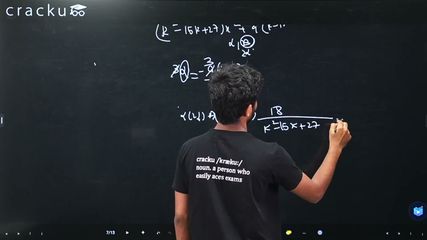
$$\text{Sum of roots: } 3\alpha = \frac{-9(k - 1)}{k^2 - 15k + 27} \implies \alpha = \frac{-3(k - 1)}{k^2 - 15k + 27} \quad \text{--- (Equation 1)}$$
$$\text{Product of roots: } 2\alpha^2 = \frac{18}{k^2 - 15k + 27} \implies \alpha^2 = \frac{9}{k^2 - 15k + 27} \quad \text{--- (Equation 2)}$$
$$\left( \frac{-3(k - 1)}{k^2 - 15k + 27} \right)^2 = \frac{9}{k^2 - 15k + 27}$$
$$\frac{9(k - 1)^2}{(k^2 - 15k + 27)^2} = \frac{9}{k^2 - 15k + 27}$$
Since $$k^2 - 15k + 27 \neq 0$$ for a valid quadratic equation, we can cancel out common terms from both sides:
$$(k - 1)^2 = k^2 - 15k + 27$$
$$k^2 - 2k + 1 = k^2 - 15k + 27$$
$$13k = 26 \implies k = 2$$
$$\text{Length of Latus Rectum} = 6k = 6(2) = 12$$
Was this solution helpful?
Click on the Email ☝️ to Watch the Video Solution
Create a FREE account and get:
_1.webp)

Educational materials for JEE preparation

Ask our AI anything

AI can make mistakes. Please verify important information.
AI can make mistakes. Please verify important information.


