Sign in
Please select an account to continue using cracku.in
↓ →

Join Our JEE Preparation Group
Prep with like-minded aspirants; Get access to free daily tests and study material.
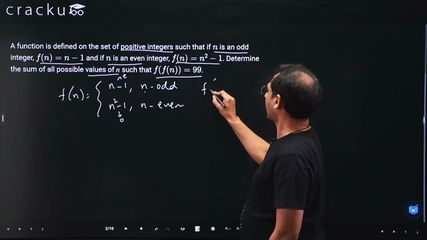
A function is defined on the set of positive integers such that if $$𝑛$$ is an odd integer, $$𝑓(𝑛) = 𝑛 − 1$$ and if $$𝑛$$ is an even integer, $$𝑓(𝑛) = n^{2} - 1$$. Determine the sum of all possible values of 𝑛 such that $$𝑓(𝑓(𝑛)) = 99$$.
Correct Answer: 11
First write the definition of the function.
If $$n$$ is odd, $$f(n)=n-1$$ (which is even).
If $$n$$ is even, $$f(n)=n^{2}-1$$ (which is odd).
We want all positive integers $$n$$ for which $$f(f(n))=99$$.
Case 1:$$n$$ is odd.
Then $$f(n)=n-1$$ (even).
Apply $$f$$ again: $$f(f(n))=(n-1)^{2}-1$$ because the input is now even.
Set equal to $$99$$:
$$(n-1)^{2}-1 = 99 \;\;\Longrightarrow\;\; (n-1)^{2}=100 \;\;\Longrightarrow\;\; n-1=\pm10.$$
Since $$n$$ must be positive, $$n-1=10$$ gives $$n=11$$, while $$n-1=-10$$ gives the negative integer $$n=-9$$, which is rejected. Hence the only solution in this case is $$n=11$$.
Case 2:$$n$$ is even.
Then $$f(n)=n^{2}-1$$ (odd).
Apply $$f$$ again: $$f(f(n))=(n^{2}-1)-1 = n^{2}-2.$$
Set equal to $$99$$:
$$n^{2}-2 = 99 \;\;\Longrightarrow\;\; n^{2}=101.$$
But $$101$$ is not a perfect square, so there is no even integer $$n$$ satisfying the equation.
Combining both cases, the only valid positive integer is $$n=11$$.
Required sum of all possible values of $$n$$ = $$11$$.
Answer: 11
Was this solution helpful?
Click on the Email ☝️ to Watch the Video Solution
Book Free CAT Mentorship
Get personalized CAT strategy from a 99%iler
500+ students mentored
OTP Verification
Enter the 6-digit code sent to your phone
Booking Summary
Enter OTP
Didn't receive the OTP?
_1.webp)

Predict your JEE Main percentile, rank & performance in seconds

Educational materials for JEE preparation

Ask our AI anything

AI can make mistakes. Please verify important information.
AI can make mistakes. Please verify important information.
 91- 6303239042

