
Join Our JEE Preparation Group
Prep with like-minded aspirants; Get access to free daily tests and study material.
Sign in
Please select an account to continue using cracku.in
↓ →
Join Our JEE Preparation Group
Prep with like-minded aspirants; Get access to free daily tests and study material.
Two wires A & B are carrying currents I$$_1$$ and I$$_2$$ as shown in the figure. The separation between them is d. A third wire C carrying a current I is to be kept parallel to them at a distance x from A such that the net force acting on it is zero. The possible values of x are:
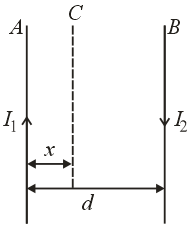
For a third parallel current-carrying wire $$C$$ to experience a net magnetic force of zero, the magnetic fields produced by wire $$A$$ ($$B_1$$) and wire $$B$$ ($$B_2$$) must be equal in magnitude but opposite in direction at the position of wire $$C$$.
$$F_{\text{net}} = 0 \implies B_1 = B_2$$
The magnetic field at a perpendicular distance $$r$$ from a long straight wire carrying current $$I$$ is given by:
$$B = \frac{\mu_0 I}{2\pi r}$$
Let's analyze the directions of the currents:
Because the currents are in opposite directions:
The exact valid region depends entirely on which current has a smaller magnitude, as wire $$C$$ must be placed closer to the weaker current to balance the stronger current's field.
Let $$x$$ be the distance from wire $$A$$ to the left. The distance from wire $$B$$ becomes $$(d + x)$$.
Equating the field magnitudes:
$$\frac{\mu_0 I_1}{2\pi x} = \frac{\mu_0 I_2}{2\pi (d + x)}$$
Cancel out the common constant factors $$\frac{\mu_0}{2\pi}$$:
$$\frac{I_1}{x} = \frac{I_2}{d + x}$$
Cross-multiply and solve for $$x$$:
$$I_1(d + x) = I_2 x$$
$$I_1 d + I_1 x = I_2 x$$
$$I_1 d = (I_2 - I_1)x$$
$$x = \frac{I_1 d}{I_2 - I_1}$$
(This solution is physically valid only if $$I_2 > I_1$$.)
If wire $$C$$ is placed to the right of wire $$B$$ at a distance $$x$$ from wire $$A$$, its distance from wire $$B$$ is $$(x - d)$$.
Equating the fields:
$$\frac{\mu_0 I_1}{2\pi x} = \frac{\mu_0 I_2}{2\pi (x - d)} \implies \frac{I_1}{x} = \frac{I_2}{x - d}$$
Cross-multiply and solve for $$x$$:
$$I_1(x - d) = I_2 x$$
$$I_1 x - I_1 d = I_2 x$$
$$(I_1 - I_2)x = I_1 d$$
$$x = \frac{I_1 d}{I_1 - I_2}$$
(This solution is physically valid only if $$I_1 > I_2$$.)
The possible values of $$x$$ depend on the relative magnitudes of the currents:
Was this solution helpful?
Create a FREE account and get:
_1.webp)

Educational materials for JEE preparation

Ask our AI anything

AI can make mistakes. Please verify important information.
AI can make mistakes. Please verify important information.
