
Join Our JEE Preparation Group
Prep with like-minded aspirants; Get access to free daily tests and study material.
Sign in
Please select an account to continue using cracku.in
↓ →
Join Our JEE Preparation Group
Prep with like-minded aspirants; Get access to free daily tests and study material.
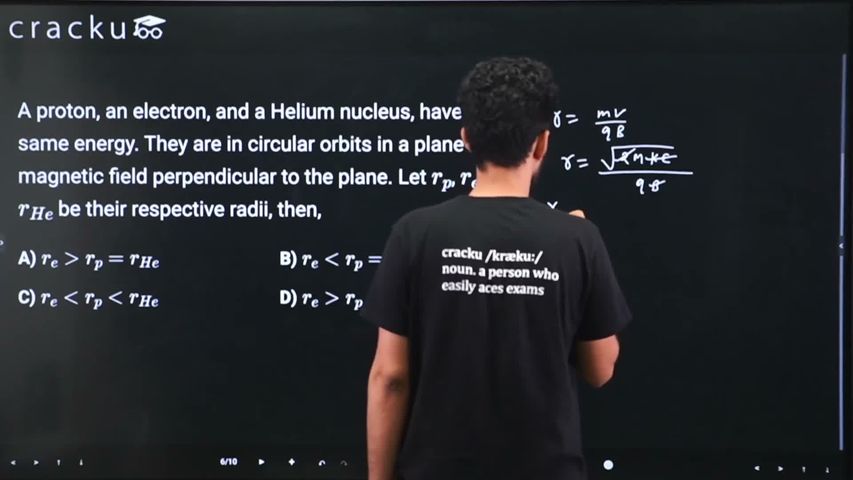
A proton, an electron, and a Helium nucleus, have the same energy. They are in circular orbits in a plane due to magnetic field perpendicular to the plane. Let $$r_p$$, $$r_e$$ and $$r_{He}$$ be their respective radii, then,
We consider a uniform magnetic field that is perpendicular to the plane of motion of the charged particle. For a charged particle of charge $$q$$ and mass $$m$$ moving with speed $$v$$ in a circle of radius $$r$$, the magnetic Lorentz force provides the required centripetal force. The relation is
$$q\,v\,B = \dfrac{m v^{2}}{r}$$
First we isolate the radius $$r$$. Cancelling one factor of $$v$$ from both sides, we obtain
$$q B = \dfrac{m v}{r} \quad \Longrightarrow \quad r = \dfrac{m v}{q B}$$
The question tells us that the proton, the electron, and the Helium nucleus all possess the same kinetic energy, which we denote by $$E$$. The kinetic energy of a particle is given by
$$E = \dfrac{1}{2} m v^{2}$$
Solving this expression for the speed $$v$$, we have
$$v = \sqrt{\dfrac{2E}{m}}$$
We now substitute this expression for $$v$$ into the formula for the radius:
$$r = \dfrac{m}{q B} \,\sqrt{\dfrac{2E}{m}}
= \dfrac{\sqrt{2 E}\, \sqrt{m}}{q B}$$
The factors $$\sqrt{2E}$$ and $$B$$ are common to all three particles because the energy and the magnetic field are the same for each. Hence, for comparison of radii, we may write the proportionality
$$r \;\propto\; \dfrac{\sqrt{m}}{q}$$
Therefore, the ordering of the radii depends solely on the ratio $$\sqrt{m}/q$$ for the proton, the electron, and the Helium nucleus. We list their masses and charges (magnitude of charge only, because radius is a positive quantity):
Now we compute the proportional factors:
$$
\begin{aligned}
r_e &\propto \dfrac{\sqrt{m_e}}{e},\\[4pt]
r_p &\propto \dfrac{\sqrt{m_p}}{e},\\[4pt]
r_{He} &\propto \dfrac{\sqrt{4 m_p}}{2e}
= \dfrac{2\sqrt{m_p}}{2e}
= \dfrac{\sqrt{m_p}}{e}.
\end{aligned}
$$
We immediately observe that
$$r_{He} \propto \dfrac{\sqrt{m_p}}{e} = r_p.$$
Thus $$r_{He} = r_p.$$ To compare with the electron, note that the electron’s mass is enormously smaller than the proton’s mass, i.e.
$$m_e \ll m_p \quad\Longrightarrow\quad \sqrt{m_e} \ll \sqrt{m_p}.$$
Consequently
$$r_e \propto \dfrac{\sqrt{m_e}}{e} \ll \dfrac{\sqrt{m_p}}{e} \propto r_p = r_{He}.$$
Collecting these results, we obtain the order
$$r_e \lt r_p = r_{He}.$$
This ordering corresponds to Option B.
Hence, the correct answer is Option B.
Was this solution helpful?
Click on the Email ☝️ to Watch the Video Solution
Create a FREE account and get:
_1.webp)

Educational materials for JEE preparation

Ask our AI anything

AI can make mistakes. Please verify important information.
AI can make mistakes. Please verify important information.
