
Join Our JEE Preparation Group
Prep with like-minded aspirants; Get access to free daily tests and study material.
Sign in
Please select an account to continue using cracku.in
↓ →
Join Our JEE Preparation Group
Prep with like-minded aspirants; Get access to free daily tests and study material.
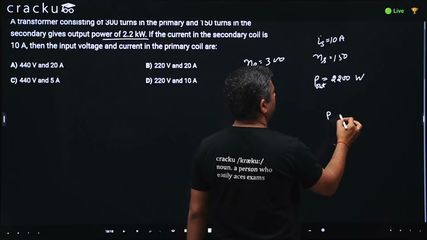
A transformer consisting of 300 turns in the primary and 150 turns in the secondary gives output power of 2.2 kW. If the current in the secondary coil is 10 A, then the input voltage and current in the primary coil are:
We have a transformer with $$N_p = 300$$ turns in the primary winding and $$N_s = 150$$ turns in the secondary winding. For an ideal transformer, the voltage ratio is given by the basic transformer turns-ratio formula
$$\frac{V_s}{V_p} = \frac{N_s}{N_p}.$$
Here $$V_p$$ is the primary (input) voltage and $$V_s$$ is the secondary (output) voltage. Substituting the given numbers, we get
$$\frac{V_s}{V_p} = \frac{150}{300} = \frac12.$$
So the secondary voltage is precisely one-half of the primary voltage:
$$V_s = \frac12\,V_p \quad\Longrightarrow\quad V_p = 2\,V_s.$$
Now, the question supplies the output power of the transformer as $$P_{\text{out}} = 2.2\ \text{kW} = 2200\ \text{W}$$ and also tells us that the current in the secondary coil is $$I_s = 10\ \text{A}.$$ Using the definition of electrical power,
$$P_{\text{out}} = V_s I_s,$$
we can determine the secondary voltage:
$$V_s = \frac{P_{\text{out}}}{I_s} = \frac{2200\ \text{W}}{10\ \text{A}} = 220\ \text{V}.$$
With $$V_s = 220\ \text{V}$$ already in hand and the earlier relation $$V_p = 2\,V_s,$$ we immediately obtain the primary voltage:
$$V_p = 2 \times 220\ \text{V} = 440\ \text{V}.$$
For an ideal transformer (neglecting losses), the input power equals the output power:
$$P_{\text{in}} = P_{\text{out}}.$$
Therefore, $$P_{\text{in}} = V_p I_p,$$ where $$I_p$$ is the primary current. Substituting the known values,
$$V_p I_p = P_{\text{out}} \quad\Longrightarrow\quad 440\ \text{V}\, \times I_p = 2200\ \text{W}.$$
Solving for $$I_p$$ gives
$$I_p = \frac{2200\ \text{W}}{440\ \text{V}} = 5\ \text{A}.$$
So the transformer must be supplied with $$440\ \text{V}$$ and will draw $$5\ \text{A}$$ from the primary source.
Hence, the correct answer is Option C.
Was this solution helpful?
Click on the Email ☝️ to Watch the Video Solution
Create a FREE account and get:
_1.webp)

Educational materials for JEE preparation

Ask our AI anything

AI can make mistakes. Please verify important information.
AI can make mistakes. Please verify important information.
