Sign in
Please select an account to continue using cracku.in
↓ →

Join Our JEE Preparation Group
Prep with like-minded aspirants; Get access to free daily tests and study material.
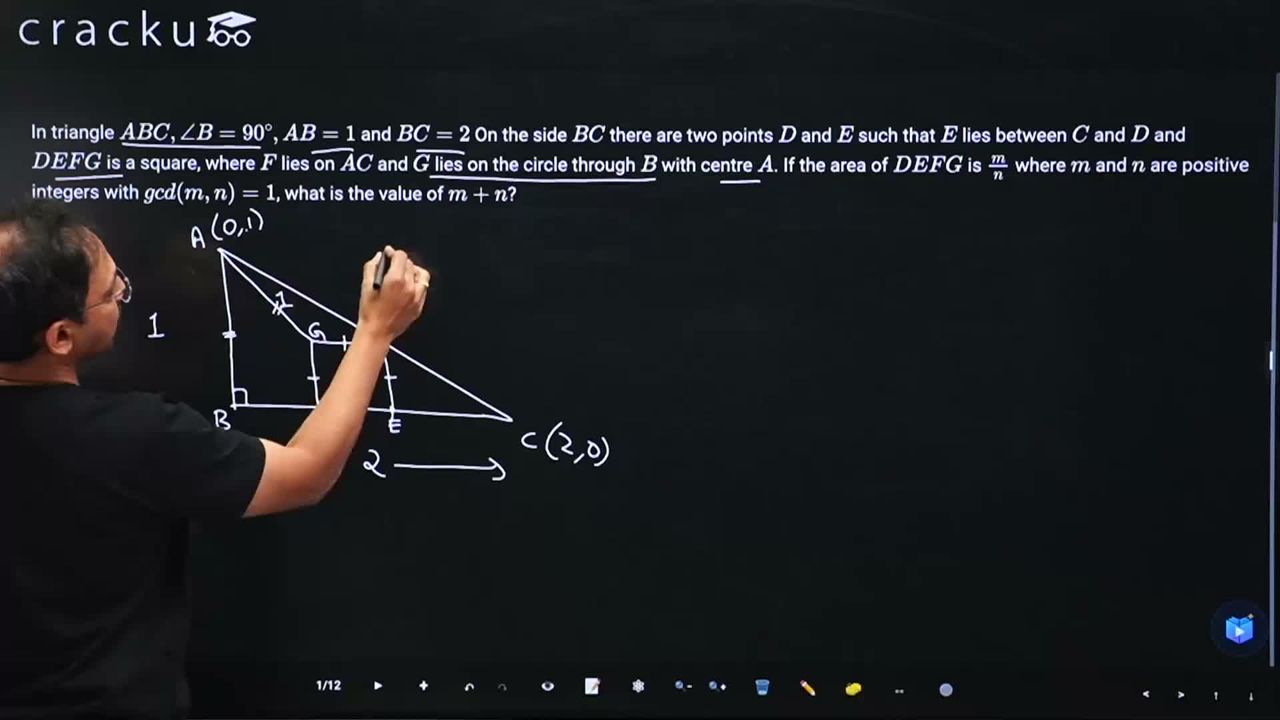
In triangle $$ABC,\angle{B} = 90^{\circ},AB =1$$ and $$BC = 2$$ On the side $$𝐵𝐶$$ there are two points $$𝐷$$ and $$𝐸$$ such that $$𝐸$$ lies between $$𝐶$$ and $$𝐷$$ and $$𝐷𝐸𝐹𝐺$$ is a square, where $$F$$ lies on $$𝐴𝐶$$ and $$𝐺$$ lies on the circle through $$B$$ with centre $$𝐴$$. If the area of $$𝐷𝐸𝐹𝐺$$ is $$\frac{m}{n}$$ where $$𝑚$$ and $$𝑛$$ are positive integers with $$gcd(𝑚, 𝑛) = 1$$, what is the value of $$𝑚 + 𝑛$$?
Correct Answer: 29
Place the triangle on the coordinate plane so that $$B(0,0)$$, $$C(2,0)$$ and $$A(0,1)$$.
Then $$BC$$ is the $$x$$-axis, $$AB$$ is the $$y$$-axis and $$AC$$ has equation $$y = 1-\dfrac{x}{2}$$.
Points $$D$$ and $$E$$ lie on $$BC$$ with $$E$$ between $$C$$ and $$D$$, so their abscissae satisfy $$0 \lt d \lt e \lt 2$$.
Let $$D(d,0)$$ and $$E(e,0)$$.
Since $$DEFG$$ is a square with $$DE$$ on $$BC$$, set the side length $$s = DE = e-d \;(\gt 0)$$.
Choose the square so that the remaining two vertices lie above $$BC$$ (inside the triangle):
$$F(e,s),\quad G(d,s).$$
1. Condition for $$F$$: it lies on $$AC$$.
Using $$y = 1-\dfrac{x}{2}$$,
$$s = 1-\dfrac{e}{2}\; \Longrightarrow\; e = 2-2s.$$
2. From $$s=e-d$$ we get
$$d = e-s = (2-2s)-s = 2-3s.$$
3. Condition for $$G$$: it lies on the circle with centre $$A(0,1)$$ and radius $$AB=1$$, i.e.
$$(d)^2 + (s-1)^2 = 1.$$(1)
Substitute $$d = 2-3s$$ into (1):
$$(2-3s)^2 + (s-1)^2 = 1$$ $$\Longrightarrow 4-12s+9s^2 + s^2-2s+1 = 1$$ $$\Longrightarrow 10s^2 -14s +5 = 1$$ $$\Longrightarrow 10s^2 -14s +4 = 0$$ $$\Longrightarrow 5s^2 -7s +2 = 0.$$
4. Solve the quadratic:
$$s = \dfrac{7 \pm \sqrt{49-40}}{10} = \dfrac{7 \pm 3}{10} \; \Longrightarrow\; s = 1 \;\text{or}\; s = \dfrac{2}{5}.$$
Because $$0 \lt d = 2-3s$$ and $$d \lt e \lt 2$$, we must have $$s \lt \dfrac{2}{3}$$, so the only admissible value is
$$s = \dfrac{2}{5}.$$
5. Area of the square:
$$\text{Area} = s^2 = \left(\dfrac{2}{5}\right)^2 = \dfrac{4}{25}.$$
This is already in lowest terms, so $$m = 4,\; n = 25$$ and
$$m+n = 4+25 = 29.$$
Final answer: 29.
Was this solution helpful?
Click on the Email ☝️ to Watch the Video Solution
Book Free CAT Mentorship
Get personalized CAT strategy from a 99%iler
500+ students mentored
OTP Verification
Enter the 6-digit code sent to your phone
Booking Summary
Enter OTP
Didn't receive the OTP?
_1.webp)

Predict your JEE Main percentile, rank & performance in seconds

Educational materials for JEE preparation

Ask our AI anything

AI can make mistakes. Please verify important information.
AI can make mistakes. Please verify important information.
 91- 6303239042

