Sign in
Please select an account to continue using cracku.in
↓ →
 CAT WhatsApp Group
The passage below is accompanied by four questions. Based on the passage, choose the best answer for each question.
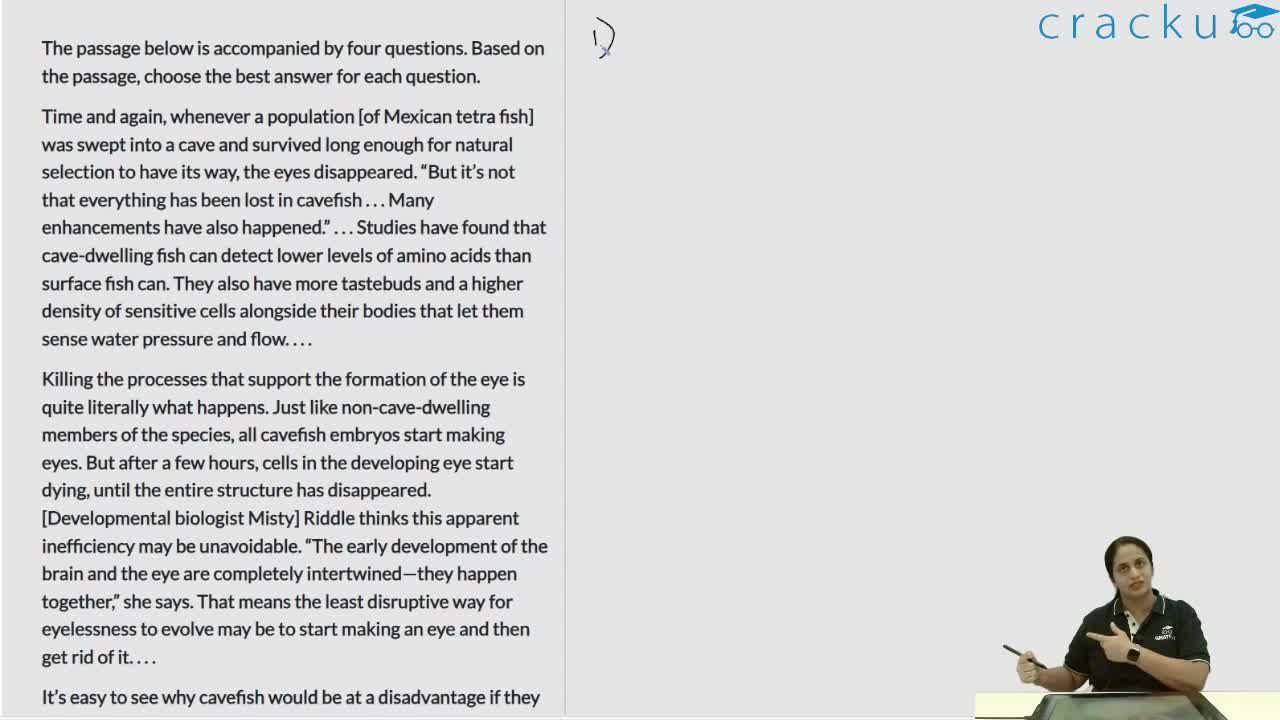
Time and again, whenever a population [of Mexican tetra fish] was swept into a cave and survived long enough for natural selection to have its way, the eyes disappeared. “But it’s not that everything has been lost in cavefish . . . Many enhancements have also happened.” . . . Studies have found that cave-dwelling fish can detect lower levels of amino acids than surface fish can. They also have more tastebuds and a higher density of sensitive cells alongside their bodies that let them sense water pressure and flow. . . .
Killing the processes that support the formation of the eye is quite literally what happens. Just like non-cave-dwelling members of the species, all cavefish embryos start making eyes. But after a few hours, cells in the developing eye start dying, until the entire structure has disappeared. [Developmental biologist Misty] Riddle thinks this apparent inefficiency may be unavoidable. “The early development of the brain and the eye are completely intertwined—they happen together,” she says. That means the least disruptive way for eyelessness to evolve may be to start making an eye and then get rid of it. . . .
It’s easy to see why cavefish would be at a disadvantage if they were to maintain expensive tissues they aren’t using. Since relatively little lives or grows in their caves, the fish are likely surviving on a meager diet of mostly bat feces and organic waste that washes in during the rainy season. Researchers keeping cavefish in labs have discovered that, genetically, the creatures are exquisitely adapted to absorbing and storing nutrients. . . .
Fats can be toxic for tissues, [evolutionary physiologist Nicolas] Rohner explains, so they are stored in fat cells. “But when these cells get too big, they can burst, which is why we often see chronic inflammation in humans and other animals that have stored a lot of fat in their tissues.” Yet a 2020 study by Rohner, Krishnan and their colleagues revealed that even very well-fed cavefish had fewer signs of inflammation in their fat tissues than surface fish do. Even in their sparse cave conditions, wild cavefish can sometimes get very fat, says Riddle. This is presumably because, whenever food ends up in the cave, the fish eat as much of it as possible, since there may be nothing else for a long time to come. Intriguingly, Riddle says, their fat is usually bright yellow because of high levels of carotenoids, the substance in the carrots that your grandmother used to tell you were good for your…eyes.
“The first thing that came to our mind, of course, was that they were accumulating these because they don’t have eyes,” says Riddle. In this species, such ideas can be tested: Scientists can cross surface fish (with eyes) and cavefish (without eyes) and look at what their offspring are like. When that’s done, Riddle says, researchers see no link between eye presence or size and the accumulation of carotenoids. Some eyeless cavefish had fat that was practically white, indicating lower carotenoid levels. Instead, Riddle thinks these carotenoids may be another adaptation to suppress inflammation, which might be important in the wild, as cavefish are likely overeating whenever food arrives.
Which one of the following results for the cross between surface fish (with eyes) and cavefish (without eyes) would invalidate Riddle’s inference from the experiment?

The experiment tests Riddle’s idea that carotenoid accumulation (yellow fat) is not linked to eye loss but serves another purpose, like reducing inflammation. To disprove this, results must show a direct connection between losing eyes and carotenoid accumulation.
Option C would directly invalidate this inference. If only the eyeless offspring had yellow fat, it would provide a strong link between the absence of eyes and carotenoid buildup. This would go against Riddle’s statement that there is “no link between eye presence or size and the accumulation of carotenoids,” and would support the earlier idea that carotenoids build up because cavefish lack eyes.
The other options do not challenge her idea. Options A and D show that white fat can appear whether or not the fish have eyes. Option B shows that fish with eyes can also have yellow fat. These results fit with Riddle’s claim that carotenoid buildup does not depend on eye presence. So, only option C would disprove her inference.
Click on the Email ☝️ to Watch the Video Solution
Create a FREE account and get:
Book Free CAT Mentorship
Get personalized CAT strategy from a 99%iler
500+ students mentored
OTP Verification
Enter the 6-digit code sent to your phone
Booking Summary
Enter OTP
Didn't receive the OTP?

Educational materials for CAT preparation

Ask our AI anything

AI can make mistakes. Please verify important information.
AI can make mistakes. Please verify important information.
 91- 6303239042