Sign in
Please select an account to continue using cracku.in
↓ →

Join Our JEE Preparation Group
Prep with like-minded aspirants; Get access to free daily tests and study material.
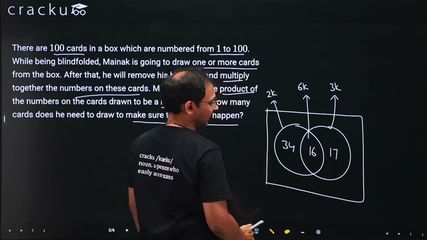
There are $$100$$ cards in a box which are numbered from $$1$$ to $$100$$. While being blindfolded, Mainak is going to draw one or more cards from the box. After that, he will remove his blindfold and multiply together the numbers on these cards. Mainak wants the product of the numbers on the cards drawn to be a multiple of $$6$$. How many cards does he need to draw to make sure that this will happen?
Correct Answer: 68
The product of the drawn numbers will be a multiple of $$6$$ exactly when the set of cards drawn supplies both a factor $$2$$ (an even number) and a factor $$3$$ (a multiple of $$3$$).
Hence Mainak fails only if, after drawing his cards, at least one of these two prime factors is still missing.
So we ask: “How many cards can be drawn while avoiding at least one of the factors $$2$$ or $$3$$?” The answer to that question, plus one more card, will give the desired guarantee.
Case 1: Avoid every even number (draw only odd cards).
There are $$50$$ odd numbers between $$1$$ and $$100$$. After drawing all $$50$$ odds the product still lacks a factor $$2$$, so it is not divisible by $$6$$.
Case 2: Avoid every multiple of $$3$$ (draw numbers not divisible by $$3$$).
Count the numbers between $$1$$ and $$100$$ that are not multiples of $$3$$:
There are $$\left\lfloor\frac{100}{3}\right\rfloor = 33$$ multiples of $$3$$, so $$100-33 = 67$$ numbers are not divisible by $$3$$.
If Mainak draws these $$67$$ cards their product has plenty of factors $$2$$ (because $$34$$ of them are even) but has no factor $$3$$, therefore the product is still not a multiple of $$6$$.
Case 2 shows that, even after drawing $$67$$ cards, Mainak could still miss the factor $$3$$, keeping the product free of $$6$$. Hence drawing $$67$$ cards is not sufficient.
However, once he draws any additional card—i.e. the $$68^{\text{th}}$$ card—he is forced to pick from the $$33$$ multiples of $$3$$ that remain in the box (by the pigeon-hole principle).
Because the first $$67$$ cards already contain even numbers, this new multiple of $$3$$ supplies the missing factor $$3$$. The combined set now has both $$2$$ and $$3$$, so its product is necessarily a multiple of $$6$$.
Therefore Mainak must draw at least $$68$$ cards to guarantee that the product of the numbers on the drawn cards is a multiple of $$6$$.
Final answer: 68.
Was this solution helpful?
Click on the Email ☝️ to Watch the Video Solution
Book Free CAT Mentorship
Get personalized CAT strategy from a 99%iler
500+ students mentored
OTP Verification
Enter the 6-digit code sent to your phone
Booking Summary
Enter OTP
Didn't receive the OTP?
_1.webp)

Predict your JEE Main percentile, rank & performance in seconds

Educational materials for JEE preparation

Ask our AI anything

AI can make mistakes. Please verify important information.
AI can make mistakes. Please verify important information.
 91- 6303239042

