
Join Our JEE Preparation Group
Prep with like-minded aspirants; Get access to free daily tests and study material.
Sign in
Please select an account to continue using cracku.in
↓ →
Join Our JEE Preparation Group
Prep with like-minded aspirants; Get access to free daily tests and study material.
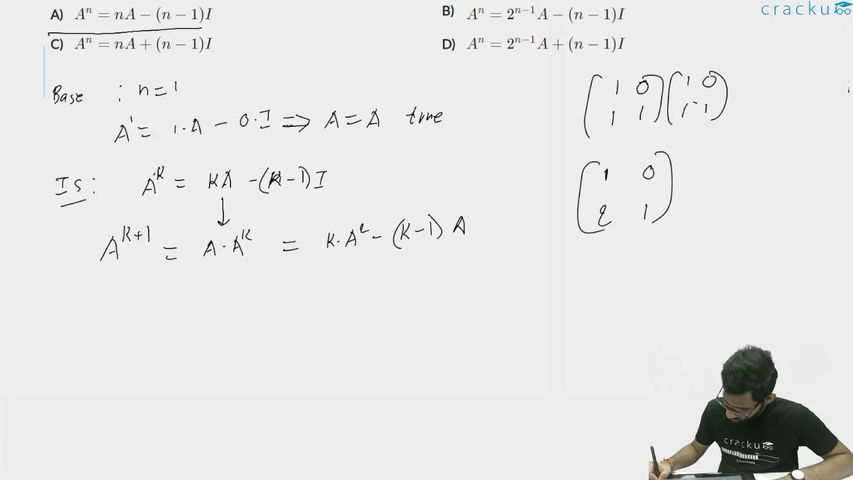
If $$A = \begin{bmatrix} 1 & 0 \\ 1 & 1 \end{bmatrix}$$ and $$I = \begin{bmatrix} 1 & 0 \\ 0 & 1 \end{bmatrix}$$, then which one of the following holds for all $$n \geq 1$$, by the principle of mathematical induction
Define the matrix $$A = \begin{bmatrix}1 & 0 \\ 1 & 1\end{bmatrix}$$ and the identity matrix $$I = \begin{bmatrix}1 & 0 \\ 0 & 1\end{bmatrix}$$. We have to show, for every integer $$n \ge 1$$, that
$$A^{\,n} = nA - (n-1)I \quad\quad -(1)$$
We prove statement (1) by the Principle of Mathematical Induction (PMI).
Base case ($$n = 1$$):
$$A^{\,1} = A$$ and $$1A - (1-1)I = A - 0\cdot I = A$$.
Thus (1) is true for $$n = 1$$.
Inductive hypothesis:
Assume (1) is true for some $$n = k \; (\ge 1)$$, i.e.
$$A^{\,k} = kA - (k-1)I \quad\quad -(2)$$
Inductive step ($$n = k+1$$):
Start with $$A^{\,k+1} = A^{\,k}\,A$$ and substitute (2):
$$A^{\,k+1} = \bigl(kA - (k-1)I\bigr)A = kA^{\,2} - (k-1)A \quad\quad -(3)$$
First compute $$A^{\,2}$$ once for all:
$$A^{\,2} = \begin{bmatrix}1 & 0 \\ 1 & 1\end{bmatrix}\begin{bmatrix}1 & 0 \\ 1 & 1\end{bmatrix} = \begin{bmatrix}1 & 0 \\ 2 & 1\end{bmatrix} \quad\quad -(4)$$
Insert (4) into (3):
$$A^{\,k+1} = k\begin{bmatrix}1 & 0 \\ 2 & 1\end{bmatrix} - (k-1)\begin{bmatrix}1 & 0 \\ 1 & 1\end{bmatrix}$$ $$= \begin{bmatrix}k & 0 \\ 2k & k\end{bmatrix} - \begin{bmatrix}k-1 & 0 \\ k-1 & k-1\end{bmatrix}$$ $$= \begin{bmatrix}k-(k-1) & 0 \\ 2k-(k-1) & k-(k-1)\end{bmatrix}$$ $$= \begin{bmatrix}1 & 0 \\ k+1 & 1\end{bmatrix} \quad\quad -(5)$$
Now evaluate the right-hand side of (1) for $$n = k+1$$:
$$(k+1)A - kI = (k+1)\begin{bmatrix}1 & 0 \\ 1 & 1\end{bmatrix} - k\begin{bmatrix}1 & 0 \\ 0 & 1\end{bmatrix}$$ $$= \begin{bmatrix}k+1 & 0 \\ k+1 & k+1\end{bmatrix} - \begin{bmatrix}k & 0 \\ 0 & k\end{bmatrix}$$ $$= \begin{bmatrix}1 & 0 \\ k+1 & 1\end{bmatrix} \quad\quad -(6)$$
Expressions (5) and (6) are identical, so
$$A^{\,k+1} = (k+1)A - kI$$
Consequently (1) holds for $$n = k+1$$ whenever it holds for $$n = k$$. By the Principle of Mathematical Induction, statement (1) is true for all integers $$n \ge 1$$.
Hence the correct option is:
Option A which is: $$A^{\,n} = nA - (n-1)I$$.
Was this solution helpful?
Click on the Email ☝️ to Watch the Video Solution
Create a FREE account and get:
_1.webp)

Educational materials for JEE preparation

Ask our AI anything

AI can make mistakes. Please verify important information.
AI can make mistakes. Please verify important information.
