
Join Our JEE Preparation Group
Prep with like-minded aspirants; Get access to free daily tests and study material.
Sign in
Please select an account to continue using cracku.in
↓ →
Join Our JEE Preparation Group
Prep with like-minded aspirants; Get access to free daily tests and study material.
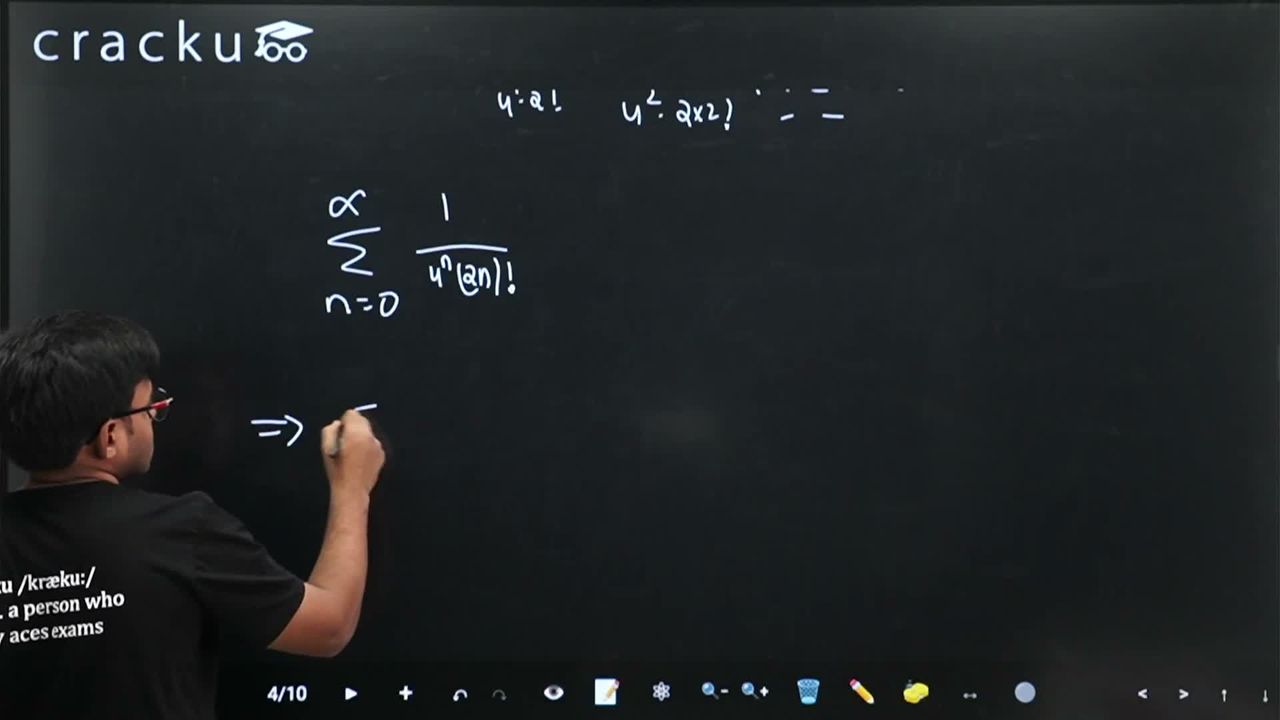
The sum of the series $$1 + \frac{1}{4 \cdot 2!} + \frac{1}{16 \cdot 4!} + \frac{1}{64 \cdot 6!} + \ldots$$ ad inf. is
The given infinite series is
$$S \;=\;1+\frac{1}{4\cdot2!}+\frac{1}{16\cdot4!}+\frac{1}{64\cdot6!}+\ldots$$
Write the general ($$n^{\text{th}}$$) term:
For $$n=0,1,2,\ldots$$ the denominator contains $$4^n$$ and $$(2n)!$$, so
$$T_n \;=\;\frac{1}{4^n\,(2n)!}$$
Hence
$$S \;=\;\sum_{n=0}^{\infty}\frac{1}{4^n\,(2n)!}$$
Notice that $$4^n=(2^2)^n=2^{2n}$$, therefore
$$\frac{1}{4^n}=\frac{1}{2^{2n}}=\left(\frac12\right)^{2n}$$
Substituting, we get
$$S \;=\;\sum_{n=0}^{\infty}\frac{\left(\dfrac12\right)^{2n}}{(2n)!}$$
Recall the Maclaurin expansion of the hyperbolic cosine:
$$\cosh x \;=\;\sum_{n=0}^{\infty}\frac{x^{2n}}{(2n)!}$$
Comparing the two series, set $$x=\dfrac12$$. Then
$$S = \cosh\!\left(\frac12\right)$$
Evaluate $$\cosh\left(\dfrac12\right):$$
$$\cosh x = \frac{e^{x}+e^{-x}}{2}$$, so with $$x=\dfrac12$$,
$$S = \frac{e^{1/2}+e^{-1/2}}{2}
= \frac{\sqrt{e}+\dfrac{1}{\sqrt{e}}}{2}
= \frac{e+1}{2\sqrt{e}}$$
Therefore, the required sum is $$\dfrac{e+1}{2\sqrt{e}}$$.
Option D which is: $$\dfrac{e + 1}{2\sqrt{e}}$$
Was this solution helpful?
Click on the Email ☝️ to Watch the Video Solution
Create a FREE account and get:
_1.webp)

Educational materials for JEE preparation

Ask our AI anything

AI can make mistakes. Please verify important information.
AI can make mistakes. Please verify important information.
