
Join Our JEE Preparation Group
Prep with like-minded aspirants; Get access to free daily tests and study material.
Sign in
Please select an account to continue using cracku.in
↓ →
Join Our JEE Preparation Group
Prep with like-minded aspirants; Get access to free daily tests and study material.
Curved surfaces of a plano-convex lens of refractive index $$\mu_1$$ and a plano-concave lens of refractive index $$\mu_2$$ have equal radius of curvature as shown in figure. Find the ratio of radius of curvature to the focal length of the combined lenses.
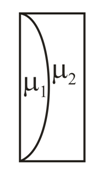
We need to find the ratio of the radius of curvature to the focal length of the combined lens system consisting of a plano-convex lens and a plano-concave lens placed in contact.
For the plano-convex lens with a refractive index of $$\mu_1$$:
Applying the Lens Maker's Formula for the first lens ($$f_1$$):
$$\frac{1}{f_1} = (\mu_1 - 1) \left( \frac{1}{R_1} - \frac{1}{R_2} \right)$$
$$\frac{1}{f_1} = (\mu_1 - 1) \left( \frac{1}{R} - \frac{1}{\infty} \right) = \frac{\mu_1 - 1}{R}$$
For the plano-concave lens with a refractive index of $$\mu_2$$:
Applying the Lens Maker's Formula for the second lens ($$f_2$$):
$$\frac{1}{f_2} = (\mu_2 - 1) \left( \frac{1}{R_1'} - \frac{1}{R_2'} \right)$$
$$\frac{1}{f_2} = (\mu_2 - 1) \left( \frac{1}{R} - \frac{1}{\infty} \right) = \frac{\mu_2 - 1}{R}$$
Note: Depending on the standard sign convention configuration where the boundaries face left-to-right, one lens has a positive curvature boundary and the other acts negatively. Let's look closely at the diagram interface: the boundary curved line bulges toward the right. For the first lens, the second boundary is curved ($$R_2 = -R$$) and the first boundary is flat ($$R_1 = \infty$$). Let's calculate using this standard orientation:
Lens 1 (Plano-Convex): First surface is flat ($$R_1 = \infty$$), second surface is concave towards the medium ($$R_2 = -R$$):
$$\frac{1}{f_1} = (\mu_1 - 1) \left( \frac{1}{\infty} - \frac{1}{-R} \right) = \frac{\mu_1 - 1}{R}$$
Lens 2 (Plano-Concave): First surface is convex towards the medium ($$R_1' = -R$$), second surface is flat ($$R_2' = \infty$$):
$$\frac{1}{f_2} = (\mu_2 - 1) \left( \frac{1}{-R} - \frac{1}{\infty} \right) = \frac{-(\mu_2 - 1)}{R}$$
When two thin lenses are kept in close contact, the equivalent focal length ($$f$$) of the combination is given by:
$$\frac{1}{f} = \frac{1}{f_1} + \frac{1}{f_2}$$
$$\frac{1}{f} = \frac{\mu_1 - 1}{R} + \frac{-(\mu_2 - 1)}{R}$$
$$\frac{1}{f} = \frac{\mu_1 - 1 - \mu_2 + 1}{R} = \frac{\mu_1 - \mu_2}{R}$$
We need to find the ratio of the radius of curvature ($$R$$) to the total focal length ($$f$$):
$$\frac{R}{f} = R \times \left(\frac{1}{f}\right) = R \times \left(\frac{\mu_1 - \mu_2}{R}\right) = \mu_1 - \mu_2$$
Final Answer: $$\mu_1 - \mu_2$$
Create a FREE account and get:
_1.webp)

Educational materials for JEE preparation

Ask our AI anything

AI can make mistakes. Please verify important information.
AI can make mistakes. Please verify important information.


