
Join Our JEE Preparation Group
Prep with like-minded aspirants; Get access to free daily tests and study material.
Sign in
Please select an account to continue using cracku.in
↓ →
Join Our JEE Preparation Group
Prep with like-minded aspirants; Get access to free daily tests and study material.
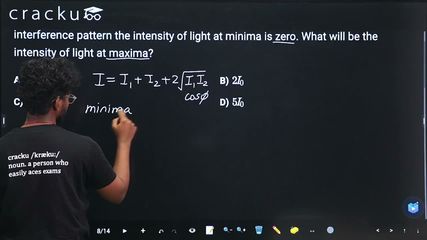
The light waves from two coherent sources have same intensity $$I_1 = I_2 = I_0$$. In interference pattern the intensity of light at minima is zero. What will be the intensity of light at maxima?
For two coherent light waves, the superposition principle gives the resultant intensity as
$$I \;=\; I_1\;+\;I_2\;+\;2\sqrt{I_1I_2}\cos\phi,$$
where $$I_1$$ and $$I_2$$ are the individual intensities and $$\phi$$ is the phase difference between the waves.
We are told that both sources have equal intensity $$I_1 = I_2 = I_0$$. Substituting these values, we obtain
$$I \;=\; I_0 \;+\; I_0 \;+\; 2\sqrt{I_0\cdot I_0}\cos\phi.$$
Since $$\sqrt{I_0\cdot I_0} = I_0,$$ this simplifies to
$$I \;=\; 2I_0 \;+\; 2I_0\cos\phi.$$
Now, the problem statement mentions that at a minimum the intensity is zero. A minimum occurs when the phase difference is an odd multiple of $$\pi$$, giving $$\cos\phi = -1$$. Substituting $$\cos\phi = -1$$ verifies the condition:
$$I_{\text{min}} = 2I_0 + 2I_0(-1) = 2I_0 - 2I_0 = 0,$$
which is consistent with the information provided.
A maximum occurs when the phase difference is an even multiple of $$\pi$$, so $$\cos\phi = 1$$. Substituting $$\cos\phi = 1$$ into the expression for $$I$$ gives
$$I_{\text{max}} = 2I_0 + 2I_0(1) = 2I_0 + 2I_0 = 4I_0.$$
Therefore, the intensity of light at the maxima is $$4I_0$$.
Hence, the correct answer is Option C.
Click on the Email ☝️ to Watch the Video Solution
Create a FREE account and get:
_1.webp)

Educational materials for JEE preparation

Ask our AI anything

AI can make mistakes. Please verify important information.
AI can make mistakes. Please verify important information.


