
Join Our JEE Preparation Group
Prep with like-minded aspirants; Get access to free daily tests and study material.
Sign in
Please select an account to continue using cracku.in
↓ →
Join Our JEE Preparation Group
Prep with like-minded aspirants; Get access to free daily tests and study material.
A square loop of side 20 cm and resistance 1 $$\Omega$$ is moved towards right with a constant speed $$v_0$$. The right arm of the loop is in a uniform magnetic field of 5 T. The field is perpendicular to the plane of the loop and is going into it. The loop is connected to a network of resistors each of value 4$$\Omega$$. What should be the value of $$v_0$$ so that a steady current of 2 mA flows in the loop?
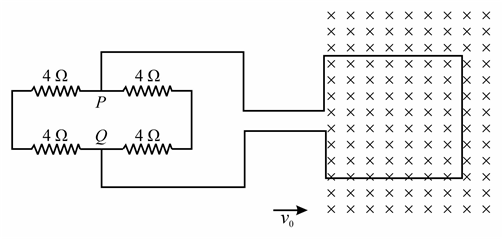
We need to determine the constant speed $$v_0$$ of a square loop so that a steady current of $$2\text{ mA}$$ flows through it as it moves through a magnetic field and interacts with an external resistor network.
From the layout described on the page, the loop is connected to an infinite or balanced grid network of resistors where each resistor has a value of $$R_0 = 4\ \Omega$$.
$$R_{\text{net}} = R_0 = 4\ \Omega$$
$$R_{\text{loop}} = 1\ \Omega$$
$$R_{\text{total}} = R_{\text{loop}} + R_{\text{net}} = 1\ \Omega + 4\ \Omega = 5\ \Omega$$
As the square loop moves to the right with speed $$v_0$$, its right arm (of length $$l = 20\text{ cm} = 0.2\text{ m}$$) cuts through a uniform magnetic field ($$B = 5\text{ T}$$) going into the page. This produces a motional electromotive force ($$e$$) given by:
$$e = B \cdot l \cdot v_0$$
Substitute the given numerical values into the expression:
$$e = 5 \times 0.2 \times v_0 = 1 \cdot v_0 = v_0$$
According to Ohm's law, the steady current ($$I$$) flowing through the circuit is equal to the induced emf divided by the total resistance:
$$I = \frac{e}{R_{\text{total}}}$$
We are given that the required steady current is $$I = 2\text{ mA} = 2 \times 10^{-3}\text{ A}$$. Substitute this and our resistance values into the formula:
$$2 \times 10^{-3} = \frac{v_0}{5}$$
$$v_0 = 5 \times 2 \times 10^{-3} = 10 \times 10^{-3} = 0.01\text{ m s}^{-1}$$
Converting the velocity from meters per second ($$\text{m s}^{-1}$$) to centimeters per second ($$\text{cm s}^{-1}$$):
$$v_0 = 0.01 \times 100 = 1\text{ cm s}^{-1}$$
The speed $$v_0$$ of the loop should be $$1\text{ cm s}^{-1}$$, which matches Option C.
Was this solution helpful?
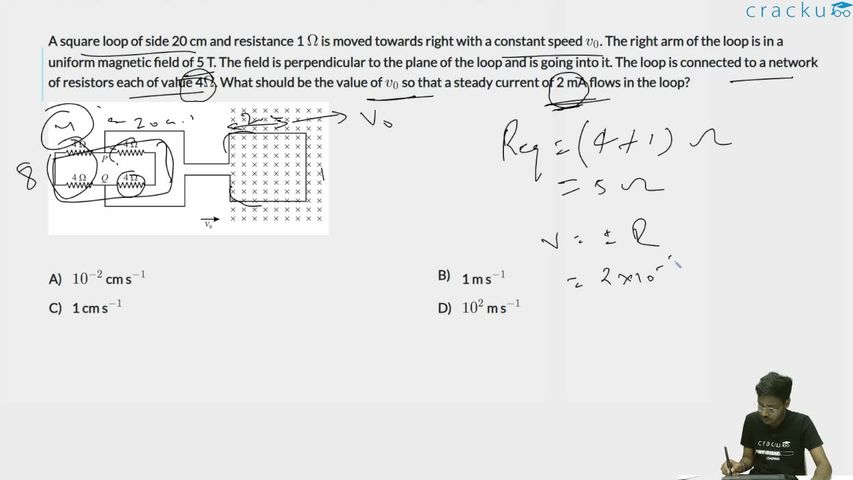
Click on the Email ☝️ to Watch the Video Solution
Create a FREE account and get:
_1.webp)

Educational materials for JEE preparation

Ask our AI anything

AI can make mistakes. Please verify important information.
AI can make mistakes. Please verify important information.
