
Join Our JEE Preparation Group
Prep with like-minded aspirants; Get access to free daily tests and study material.
Sign in
Please select an account to continue using cracku.in
↓ →
Join Our JEE Preparation Group
Prep with like-minded aspirants; Get access to free daily tests and study material.
If both the roots of the quadratic equation $$x^2 - 2kx + k^2 + k - 5 = 0$$ are less than $$5$$, then $$k$$ lies in the interval
The given quadratic is $$x^2 - 2kx + k^2 + k - 5 = 0$$ with coefficients $$a = 1,\; b = -2k,\; c = k^2 + k - 5$$.
Step 1: Condition for real roots
Real roots exist when the discriminant is non-negative:
$$\Delta = b^{2} - 4ac = (-2k)^2 - 4(1)(k^2 + k - 5)$$ $$\Delta = 4k^{2} - 4k^{2} - 4k + 20 = 4(5 - k)$$
$$\Delta \ge 0 \Longrightarrow 5 - k \ge 0 \Longrightarrow k \le 5$$
Step 2: Express the roots
Because $$a = 1,$$ the two roots are
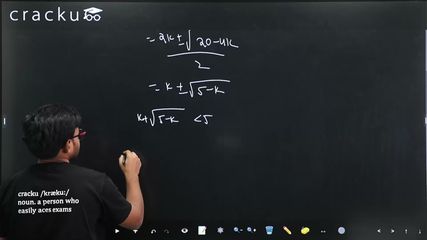
$$x = \frac{-b \pm \sqrt{\Delta}}{2a} = \frac{2k \pm 2\sqrt{5 - k}}{2} = k \pm \sqrt{5 - k}$$
The larger root is $$x_{\max} = k + \sqrt{5 - k}\,.$$ Both roots will be less than $$5$$ exactly when this larger root is less than $$5$$ (the smaller root is then automatically <5).
Step 3: Impose “both roots < 5”
$$k + \sqrt{5 - k} \lt 5$$ $$\sqrt{5 - k} \lt 5 - k$$
The right side is non-negative because $$k \le 5$$. Square both sides (permitted since both are non-negative):
$$(5 - k) \lt (5 - k)^2$$ Let $$t = 5 - k \,(\,t \ge 0\,)$$ so the inequality becomes $$t \lt t^{2}$$.
$$t^{2} - t \gt 0 \Longrightarrow t(t - 1) \gt 0$$ Since $$t \ge 0,$$ we need $$t \gt 1$$.
$$t \gt 1 \Longrightarrow 5 - k \gt 1 \Longrightarrow k \lt 4$$
Step 4: Combine all conditions
Real roots needed $$k \le 5$$; the “both roots <5” requirement tightened this to $$k \lt 4$$.
Hence
$$k \in (-\infty,\,4)$$
That interval corresponds to Option C which is: $$(-\infty, 4)$$.
Was this solution helpful?
Click on the Email ☝️ to Watch the Video Solution
Create a FREE account and get:
_1.webp)

Educational materials for JEE preparation

Ask our AI anything

AI can make mistakes. Please verify important information.
AI can make mistakes. Please verify important information.
