
Join Our JEE Preparation Group
Prep with like-minded aspirants; Get access to free daily tests and study material.
Sign in
Please select an account to continue using cracku.in
↓ →
Join Our JEE Preparation Group
Prep with like-minded aspirants; Get access to free daily tests and study material.
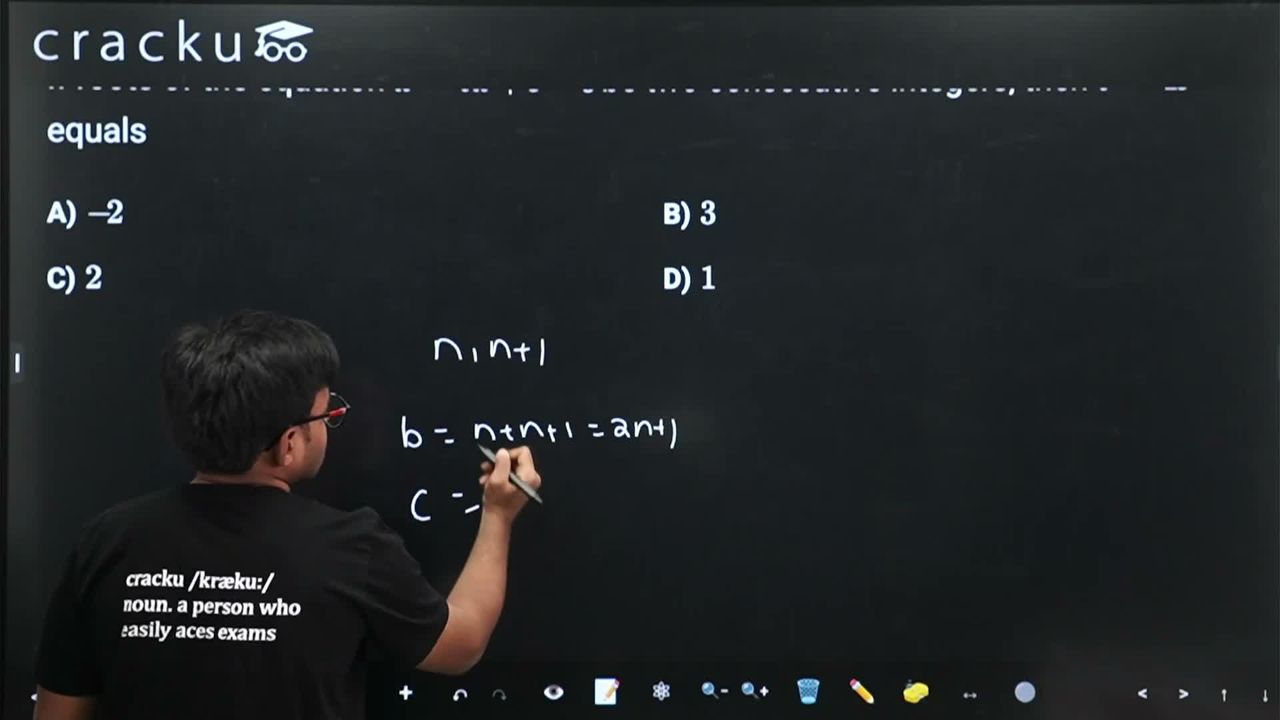
If roots of the equation $$x^2 - bx + c = 0$$ be two consecutive integers, then $$b^2 - 4c$$ equals
Let the two consecutive integral roots be $$n$$ and $$n+1$$, where $$n$$ is an integer.
For the quadratic $$x^2 - bx + c = 0$$, Vieta’s relations give
Sum of roots $$= n + (n+1) = 2n + 1 = b$$ $$-(1)$$
Product of roots $$= n(n+1) = c$$ $$-(2)$$
We need $$b^2 - 4c$$. Substitute from $$-(1)$$ and $$-(2)$$:
$$b^2 - 4c = (2n + 1)^2 - 4\bigl[n(n+1)\bigr]$$
Expand each term:
$$(2n + 1)^2 = 4n^2 + 4n + 1$$
$$4\,n(n+1) = 4n^2 + 4n$$
Subtract:
$$b^2 - 4c = (4n^2 + 4n + 1) - (4n^2 + 4n) = 1$$
The expression is independent of the specific integer $$n$$; it always equals $$1$$.
Hence, $$b^2 - 4c = 1$$, which corresponds to
Option D which is: $$1$$
Was this solution helpful?
Click on the Email ☝️ to Watch the Video Solution
Create a FREE account and get:
_1.webp)

Educational materials for JEE preparation

Ask our AI anything

AI can make mistakes. Please verify important information.
AI can make mistakes. Please verify important information.
