Sign in
Please select an account to continue using cracku.in
↓ →

Join Our JEE Preparation Group
Prep with like-minded aspirants; Get access to free daily tests and study material.
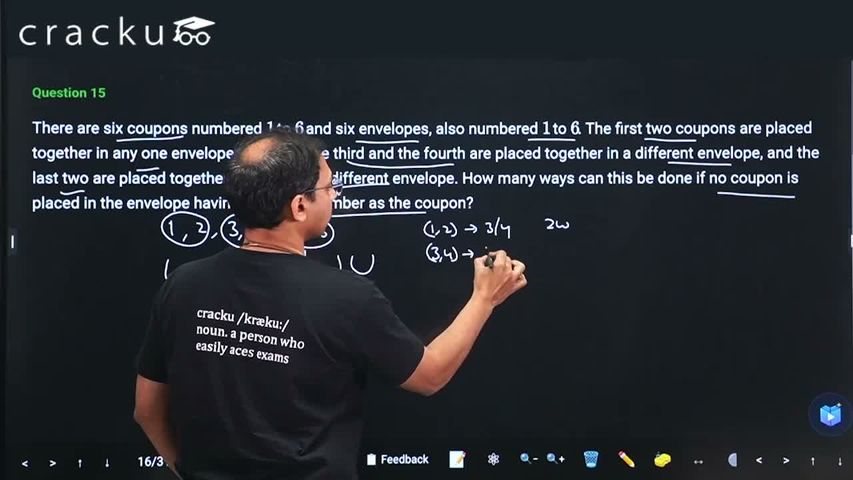
There are six coupons numbered $$1$$ to $$6$$ and six envelopes, also numbered $$1$$ to $$6$$. The first two coupons are placed together in any one envelope. Similarly, the third and the fourth are placed together in a different envelope, and the last two are placed together in yet another different envelope. How many ways can this be done if no coupon is placed in the envelope having the same number as the coupon?
Correct Answer: 40
Think of the three coupon-pairs as three distinct “objects”:
$$P_1 = (1,2), \; P_2 = (3,4), \; P_3 = (5,6).$$
Each pair must be placed in one envelope and no two pairs may share an envelope, so we are choosing an injective function from $$\{P_1,P_2,P_3\}$$ to the six envelopes $$\{1,2,3,4,5,6\}$$.
First count the total number of injective assignments with no restriction. This is a permutation of 6 envelopes taken 3 at a time:
$$\text{Total} = {}^{6}P_{3} = 6 \times 5 \times 4 = 120.$$
Define events that violate the given condition “no coupon goes into the envelope bearing its own number”:
$$\begin{aligned} E_1 &: P_1 \text{ goes into envelope }1\text{ or }2,\\ E_2 &: P_2 \text{ goes into envelope }3\text{ or }4,\\ E_3 &: P_3 \text{ goes into envelope }5\text{ or }6. \end{aligned}$$
We require an arrangement in which none of $$E_1,E_2,E_3$$ occurs. Use the Principle of Inclusion-Exclusion (PIE).
Case 1: exactly one event holdsExample for $$E_1$$:
• Choose an envelope for $$P_1$$ (two choices: 1 or 2).
• Place $$P_2,P_3$$ in any two of the remaining five envelopes: $$^{5}P_{2}=5 \times 4=20$$ ways.
Thus $$|E_1| = 2 \times 20 = 40.$$
By symmetry $$|E_2| = 40,\; |E_3| = 40.$$
Sum over single events:
$$\sum |E_i| = 40+40+40 = 120.$$
Case 2: exactly two events holdExample for $$E_1\cap E_2$$:
• Choose envelope for $$P_1$$: 2 ways (1 or 2).
• Choose envelope for $$P_2$$: 2 ways (3 or 4). (These choices are in disjoint sets, so they never clash.)
• Now $$P_3$$ can go to any of the remaining four envelopes: 4 ways.
Hence $$|E_1\cap E_2| = 2 \times 2 \times 4 = 16.$$
Similarly $$|E_1\cap E_3| = 16, \; |E_2\cap E_3| = 16.$
Sum over pairwise intersections:
$$$$\sum$$ |E_i$$\cap$$ E_j| = 16+16+16 = 48.$$
Case 3: all three events holdEach pair goes into one of its two “forbidden” envelopes, all sets being disjoint:
$$|E_1$$\cap$$ E_2$$\cap$$ E_3| = 2 $$\times$$ 2 $$\times$$ 2 = 8.$$
Apply PIE:
$$ $$\begin{aligned}$$ $$\text{Valid arrangements}$$ &= 120 \;-\; 120 \;+\; 48 \;-\; 8\\[4pt] &= 40. \end{aligned} $$
Therefore, the required number of ways is 40.
Was this solution helpful?
Click on the Email ☝️ to Watch the Video Solution
Book Free CAT Mentorship
Get personalized CAT strategy from a 99%iler
500+ students mentored
OTP Verification
Enter the 6-digit code sent to your phone
Booking Summary
Enter OTP
Didn't receive the OTP?
_1.webp)

Predict your JEE Main percentile, rank & performance in seconds

Educational materials for JEE preparation

Ask our AI anything

AI can make mistakes. Please verify important information.
AI can make mistakes. Please verify important information.
 91- 6303239042

