Sign in
Please select an account to continue using cracku.in
↓ →

Join Our JEE Preparation Group
Prep with like-minded aspirants; Get access to free daily tests and study material.
If $$𝑎, 𝑏, 𝑐, 𝑑$$ are positive integers such that $$17(𝑎𝑏𝑐𝑑 + 𝑎𝑏 + 𝑎𝑑 + 𝑐𝑑 + 1) = 20(𝑏𝑐𝑑 + 𝑏 + 𝑑),$$ find $$a^{2}+b^{2}+c^{2}+d^{2}$$.
Correct Answer: 31
Let $$a,b,c,d$$ be positive integers satisfying
$$17\bigl(abcd+ab+ad+cd+1\bigr)=20\bigl(bcd+b+d\bigr)\quad -(1)$$
Step 1 Introduce the common factor $$S=bcd+b+d$$.
Because $$\gcd(17,20)=1,$$ equation (1) forces
$$17\mid S\;\Longrightarrow\;S=17k,\;k\in\mathbb{N}$$
and consequently
$$20\mid\bigl(abcd+ab+ad+cd+1\bigr).$$
Step 2 Rewrite the left‐hand expression in terms of $$S$$.
Note that
$$abcd+ab+ad+cd+1=a(bcd+b+d)+cd+1=aS+cd+1.$$
Substituting this and $$S=17k$$ in (1):
$$17\bigl(aS+cd+1\bigr)=20S
\;\Longrightarrow\;
17aS+17(cd+1)=20S.$$
Divide by $$17$$ and replace $$S$$ by $$17k$$:
$$a(17k)=20k-cd-1
\;\Longrightarrow\;
(20-17a)k=cd+1\quad -(2)$$
Step 3 Fix the only possible value of $$a$$.
All quantities are positive, so the left side of (2) must be positive:
$$20-17a\gt 0\;\Longrightarrow\;a\le 1.$$
Since $$a$$ is a positive integer, we must have
$$\boxed{a=1}$$
With $$a=1$$, equation (2) becomes
$$3k=cd+1\quad -(3)$$
Step 4 Express $$k$$ and $$S$$ in terms of $$c,d$$.
From (3): $$k=\dfrac{cd+1}{3}$$ (so $$cd\equiv2\pmod 3$$).
Using $$S=17k$$:
$$S=17\bigl(\tfrac{cd+1}{3}\bigr)=\tfrac{17}{3}(cd+1).$$
Step 5 Set up the final condition for $$b,c,d$$.
But $$S=bcd+b+d$$, hence
$$bcd+b+d=\frac{17}{3}(cd+1).$$
Multiply by 3:
$$3bcd+3b+3d=17cd+17.$$
Rearrange:
$$cd(3b-17)+3(b+d)-17=0\quad -(4)$$
Step 6 Solve (4) for the small integer $$b$$.
• If $$3b-17\ge 0$$ (that is $$b\ge 6$$), then the first term in (4) is non-negative and the second term is positive, so the sum cannot be zero. Hence $$b\lt 6$$.
• List the possibilities:
Then $$3b-17=-2$$ and (4) gives
$$-2cd+3d-2=0\;\Longrightarrow\;2cd-3d+2=0$$
$$d(2c-3)=-2.$$
Because $$d,c\gt0$$, the only way is $$2c-3=-1\;(c=1)$$ and $$d=2.$$
Thus $$b=5,c=1,d=2$$ is a solution.
For these values, $$3b-17\le -5$$, so the term $$cd(3b-17)$$ is too negative to be balanced by the positive remainder $$3(b+d)-17$$, and no solution occurs.
Hence the unique positive integer solution is
$$(a,b,c,d)=(1,5,1,2).$$
Step 7 Compute the required sum of squares:
$$a^{2}+b^{2}+c^{2}+d^{2}=1^{2}+5^{2}+1^{2}+2^{2}=1+25+1+4=31.$$
Therefore, the answer is
31.
Was this solution helpful?
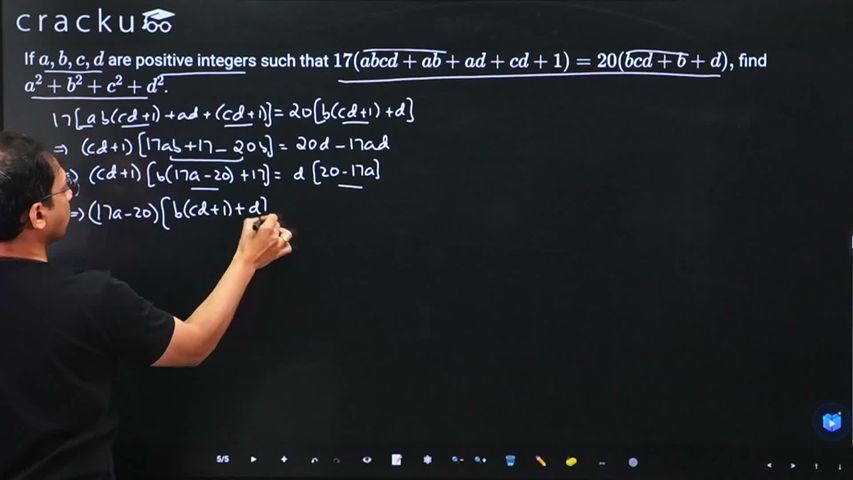
Click on the Email ☝️ to Watch the Video Solution
Book Free CAT Mentorship
Get personalized CAT strategy from a 99%iler
500+ students mentored
OTP Verification
Enter the 6-digit code sent to your phone
Booking Summary
Enter OTP
Didn't receive the OTP?
_1.webp)

Predict your JEE Main percentile, rank & performance in seconds

Educational materials for JEE preparation

Ask our AI anything

AI can make mistakes. Please verify important information.
AI can make mistakes. Please verify important information.
 91- 6303239042

