
Join Our JEE Preparation Group
Prep with like-minded aspirants; Get access to free daily tests and study material.
Sign in
Please select an account to continue using cracku.in
↓ →
Join Our JEE Preparation Group
Prep with like-minded aspirants; Get access to free daily tests and study material.
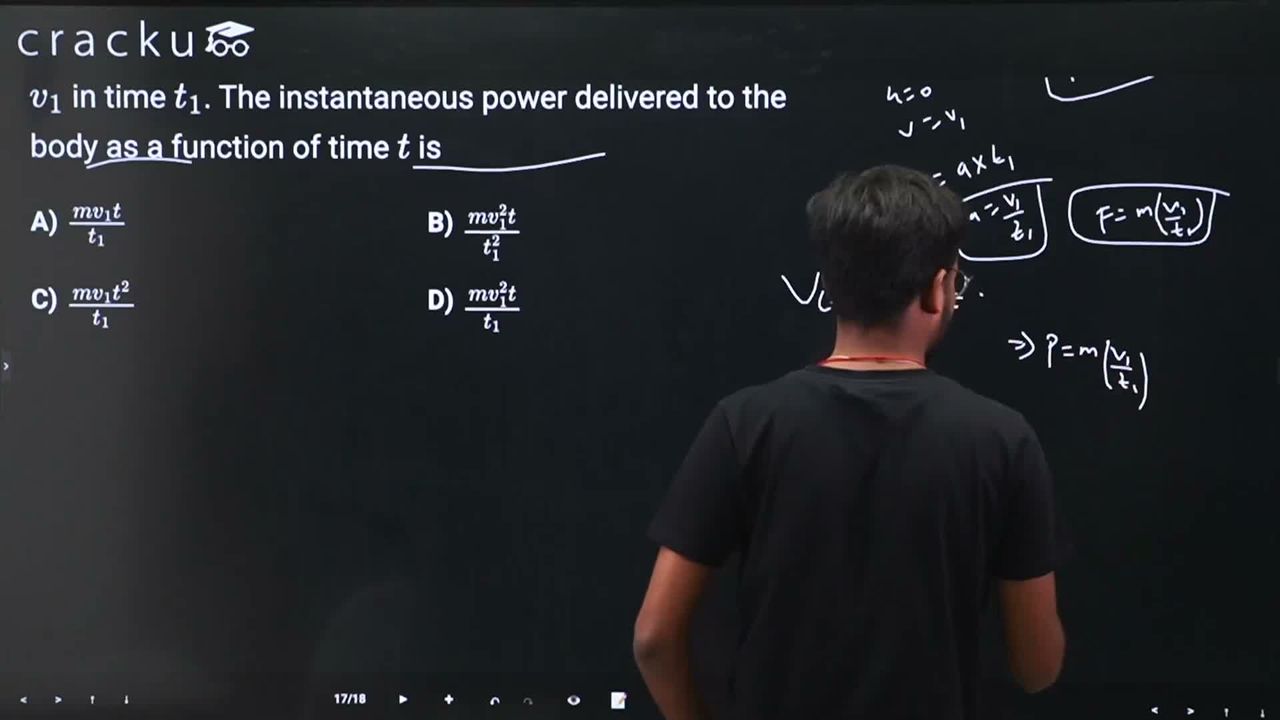
A body of mass $$m$$, accelerates uniformly from rest to $$v_1$$ in time $$t_1$$. The instantaneous power delivered to the body as a function of time $$t$$ is
The body starts from rest, which means its initial velocity ($$u$$) is zero:
$$u = 0 \,\, \text{m/s}$$
According to the first equation of motion ($$v = u + a \cdot t$$), the body reaches a velocity of $$v_1$$ in a time interval $$t_1$$. Substituting these parameters allows us to find the constant acceleration ($$a$$):
$$v_1 = 0 + a \cdot t_1$$
$$a = \frac{v_1}{t_1}$$
Now, let us find the instantaneous velocity ($$v$$) of the body at any arbitrary time token $$t$$ using the same equation of motion:
$$v = u + a \cdot t$$
$$v = 0 + \left(\frac{v_1}{t_1}\right) \cdot t$$
$$v = \frac{v_1 \cdot t}{t_1}$$
Instantaneous power delivered to a moving body is defined as the scalar product of the net force ($$F$$) acting on it and its instantaneous velocity ($$v$$):
$$P = F \cdot v$$
According to Newton's Second Law of Motion, force is the product of mass ($$m$$) and acceleration ($$a$$):
$$F = m \cdot a = m \cdot \left(\frac{v_1}{t_1}\right)$$
Substituting both the force ($$F$$) and velocity ($$v$$) expressions into the power formula yields:
$$P = \left( m \cdot \frac{v_1}{t_1} \right) \cdot \left( \frac{v_1 \cdot t}{t_1} \right)$$
$$P = \frac{m \cdot v_1^2 \cdot t}{t_1^2}$$
Concept Check: Because the acceleration is uniform, the force acting on the body remains completely constant. However, since the velocity increases linearly with time, the instantaneous power delivered to the body must also scale linearly with time ($$P \propto t$$).
Correct Option Key: Option B ($$\frac{m \cdot v_1^2 \cdot t}{t_1^2}$$)
Was this solution helpful?
Click on the Email ☝️ to Watch the Video Solution
Create a FREE account and get:
_1.webp)

Educational materials for JEE preparation

Ask our AI anything

AI can make mistakes. Please verify important information.
AI can make mistakes. Please verify important information.
