
Join Our JEE Preparation Group
Prep with like-minded aspirants; Get access to free daily tests and study material.
Sign in
Please select an account to continue using cracku.in
↓ →
Join Our JEE Preparation Group
Prep with like-minded aspirants; Get access to free daily tests and study material.
Electrical conductivity ($$\kappa$$) of an aqueous solution arises from the movement of ions. For a monoprotic acid $$HA$$ of concentration $$c$$,
$$\kappa = \Lambda_m \, c = \lambda_+ \, c\,\alpha + \lambda_- \, c\,\alpha = c\,\alpha\,(\lambda_{H^+}+\lambda_{A^-})$$
where $$\alpha$$ is the degree of ionisation and $$\lambda_i$$ are the ionic molar conductivities. At the same overall concentration $$c$$, the factor deciding $$\kappa$$ is $$\alpha$$, which in turn is governed by the acid-dissociation constant $$K_a$$:
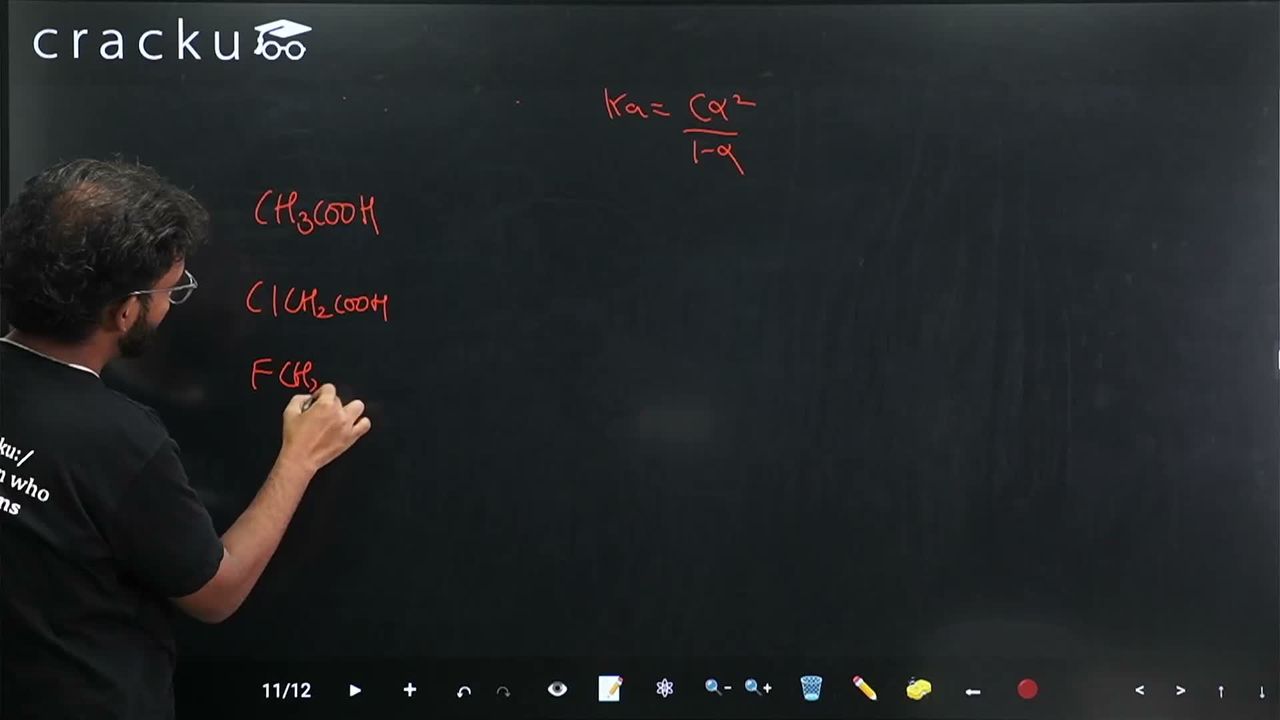
$$K_a = \frac{c\,\alpha^2}{1-\alpha} \;\;\Longrightarrow\;\; \alpha \uparrow \; \text{if} \; K_a \uparrow$$
An electron-withdrawing substituent (-I effect) stabilises the conjugate base $$A^-$$, increases $$K_a$$, and therefore increases $$\alpha$$ and $$\kappa$$.
Relative -I strengths in the given acids:
• Acetic acid $$CH_3COOH$$ : no halogen → weakest -I
• Chloroacetic acid $$ClCH_2COOH$$ : one Cl (moderate -I)
• Fluoroacetic acid $$FCH_2COOH$$ : one F (stronger -I because $$F$$ is more electronegative than $$Cl$$)
• Difluoroacetic acid $$F_2CHCOOH$$ : two $$F$$ atoms → strongest cumulative -I
Hence $$K_a$$ follows the order
$$F_2CHCOOH \gt FCH_2COOH \gt ClCH_2COOH \gt CH_3COOH$$
and so does the degree of ionisation $$\alpha$$ and the conductivity $$\kappa$$ at the same concentration $$0.1$$ M.
Therefore, the solution with the highest electrical conductivity is
Option D which is: $$0.1$$ M difluoroacetic acid
Was this solution helpful?
Click on the Email ☝️ to Watch the Video Solution
Create a FREE account and get:
_1.webp)

Educational materials for JEE preparation

Ask our AI anything

AI can make mistakes. Please verify important information.
AI can make mistakes. Please verify important information.
