
Join Our JEE Preparation Group
Prep with like-minded aspirants; Get access to free daily tests and study material.
Sign in
Please select an account to continue using cracku.in
↓ →
Join Our JEE Preparation Group
Prep with like-minded aspirants; Get access to free daily tests and study material.
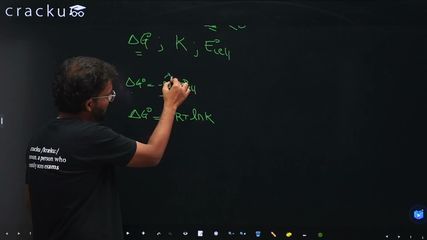
For a spontaneous reaction the $$\Delta G$$, equilibrium constant ($$K$$) and $$E^\circ_{cell}$$ will be respectively
For any chemical process the three quantities are related by the well-known thermodynamic equations:
1. $$\Delta G^\circ = -\,n\,F\,E^\circ_{cell}$$
2. $$\Delta G^\circ = -\,RT \ln K$$
Here $$\Delta G^\circ$$ is the standard Gibbs free-energy change, $$E^\circ_{cell}$$ is the standard cell potential, and $$K$$ is the equilibrium constant.
For a reaction to be spontaneous under standard conditions we must have $$\Delta G^\circ \lt 0$$. Substituting this negative value in the two equations above:
• In equation (1) a negative $$\Delta G^\circ$$ implies $$E^\circ_{cell}$$ must be positive because $$nF$$ (number of electrons × Faraday constant) is always positive.
• In equation (2) a negative $$\Delta G^\circ$$ gives $$\ln K \gt 0$$, which means $$K \gt 1$$.
Thus, for a spontaneous reaction:
$$\Delta G^\circ$$ is negative (−ve), $$K \gt 1$$, and $$E^\circ_{cell}$$ is positive (+ve).
Option A which is: −ve, >1, +ve
Was this solution helpful?
Click on the Email ☝️ to Watch the Video Solution
Create a FREE account and get:
_1.webp)

Educational materials for JEE preparation

Ask our AI anything

AI can make mistakes. Please verify important information.
AI can make mistakes. Please verify important information.
