
Join Our JEE Preparation Group
Prep with like-minded aspirants; Get access to free daily tests and study material.
Sign in
Please select an account to continue using cracku.in
↓ →
Join Our JEE Preparation Group
Prep with like-minded aspirants; Get access to free daily tests and study material.
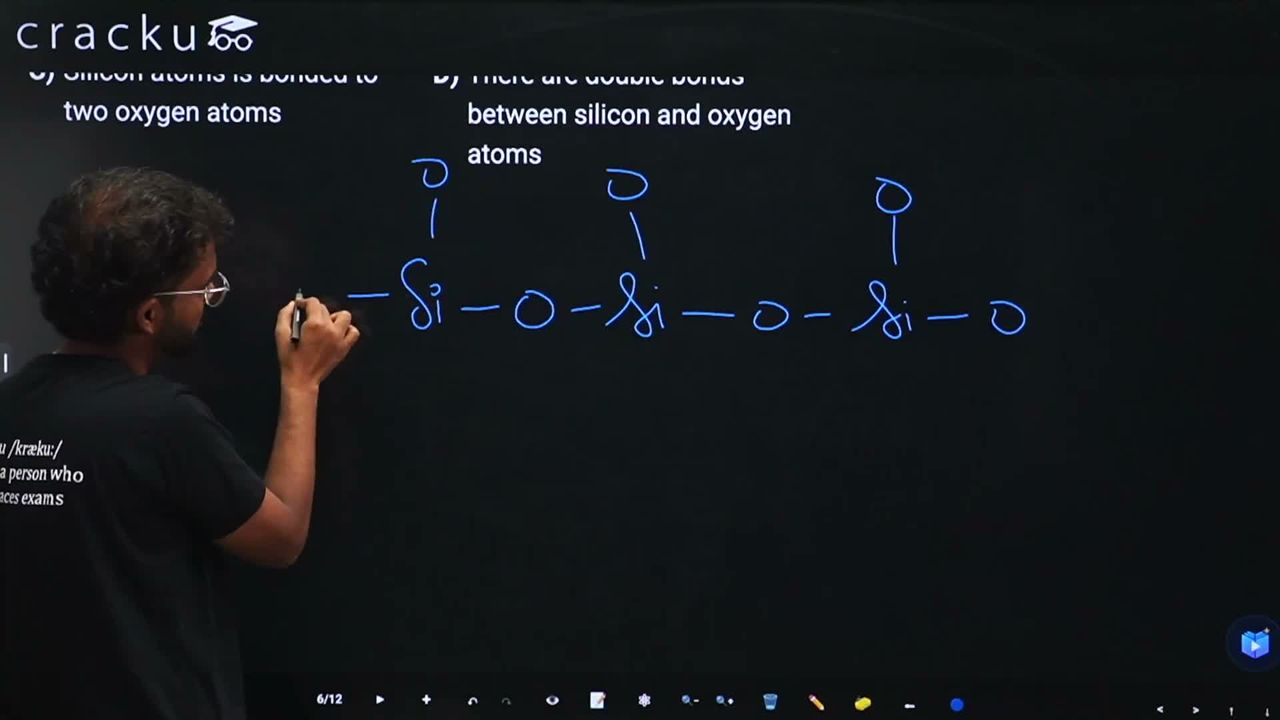
Silicon dioxide, $$SiO_2$$, does not exist as discrete $$SiO_2$$ molecules. Instead, it forms a three-dimensional covalent network similar to quartz.
Key structural features of this network:
1. Each silicon atom is at the centre of a regular tetrahedron formed by four oxygen atoms. The $$Si-O$$ bond length is the same for all four bonds.
2. Each oxygen atom acts as a bridge (a “bridging oxygen”) between two different silicon atoms. Hence an oxygen completes its octet by forming two single $$Si-O$$ bonds, one to each adjacent silicon.
Because of this extended network:
• Every silicon atom has a coordination number of 4 (tetrahedral).
• Every oxygen atom has a coordination number of 2.
• All $$Si-O$$ bonds are single bonds; there are no $$Si=O$$ double bonds in the solid.
Now check the options:
Option A: “Each silicon atom is surrounded by four oxygen atoms and each oxygen atom is bonded to two silicon atoms.” — This matches the network described above. ✔️
Option B: Gives coordination 2 for silicon, which is incorrect. ✖️
Option C: Again states silicon is bonded only to two oxygens, wrong for the network solid. ✖️
Option D: Mentions double bonds $$Si=O$$, which are absent in crystalline $$SiO_2$$. ✖️
Therefore, the correct statement is:
Option A which is: Each silicon atom is surrounded by four oxygen atoms and each oxygen atom is bonded to two silicon atoms.
Was this solution helpful?
Click on the Email ☝️ to Watch the Video Solution
Create a FREE account and get:
_1.webp)

Educational materials for JEE preparation

Ask our AI anything

AI can make mistakes. Please verify important information.
AI can make mistakes. Please verify important information.
