
Join Our JEE Preparation Group
Prep with like-minded aspirants; Get access to free daily tests and study material.
Sign in
Please select an account to continue using cracku.in
↓ →
Join Our JEE Preparation Group
Prep with like-minded aspirants; Get access to free daily tests and study material.
Aluminium chloride is a largely covalent chloride because the highly charged, small $$Al^{3+}$$ ion polarises the chloride ions. When such covalent chlorides are dissolved in water, they undergo extensive hydrolysis.
Step 1 - Hydrolysis in water:
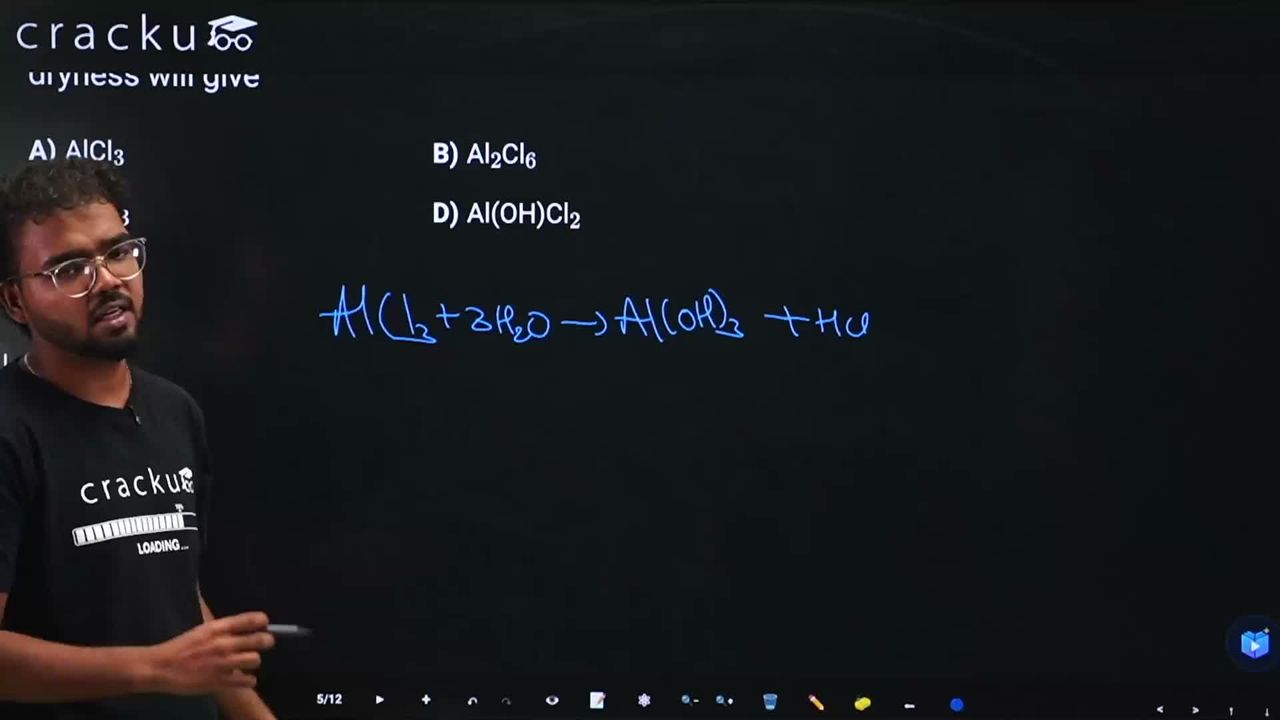
$$AlCl_3 + 3\,H_2O \;\longrightarrow\; Al(OH)_3 + 3\,HCl$$
During this step, hydrochloric acid escapes as a gas (or stays in solution and can later be boiled off), leaving gelatinous aluminium hydroxide behind.
Step 2 - Heating to dryness:
On strong heating, the hydroxide loses water (dehydration):
$$2\,Al(OH)_3 \;\xrightarrow{\;\text{heat}\;} Al_2O_3 + 3\,H_2O$$
The final solid residue after all water has been driven off is aluminium oxide, $$Al_2O_3$$.
Hence, heating an aqueous solution of aluminium chloride to dryness ultimately gives aluminium oxide.
Option C which is: $$Al_2O_3$$
Was this solution helpful?
Click on the Email ☝️ to Watch the Video Solution
Create a FREE account and get:
_1.webp)

Educational materials for JEE preparation

Ask our AI anything

AI can make mistakes. Please verify important information.
AI can make mistakes. Please verify important information.
