
Join Our JEE Preparation Group
Prep with like-minded aspirants; Get access to free daily tests and study material.
Sign in
Please select an account to continue using cracku.in
↓ →
Join Our JEE Preparation Group
Prep with like-minded aspirants; Get access to free daily tests and study material.
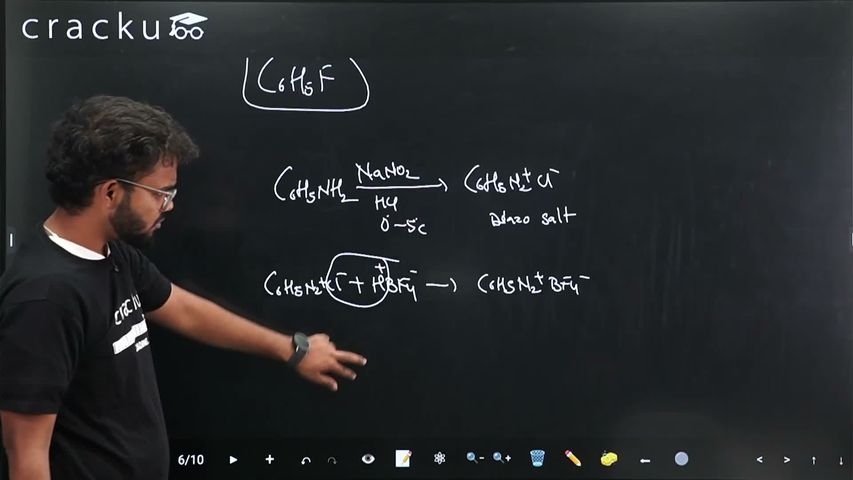
The laboratory synthesis of fluorobenzene relies on converting an aromatic amine into an arenediazonium salt and then replacing the diazonium group by fluorine. This two-step sequence is known as the Balz-Schiemann reaction.
Step 1 : Diazotisation of aniline
Aniline is treated with cold $$NaNO_2$$ and $$HCl$$ (0-5 °C) to give benzenediazonium chloride:
$$C_6H_5NH_2 + NaNO_2 + 2HCl \rightarrow C_6H_5N_2^+Cl^- + NaCl + 2H_2O$$
Step 2 : Formation of diazonium tetrafluoroborate and thermal decomposition
The diazonium chloride is reacted with aqueous $$HBF_4$$ to precipitate benzenediazonium tetrafluoroborate:
$$C_6H_5N_2^+Cl^- + HBF_4 \rightarrow C_6H_5N_2^+BF_4^- + HCl$$
On gentle heating (≈ 60-70 °C) the solid diazonium salt decomposes, losing $$N_2$$ and forming fluorobenzene:
$$C_6H_5N_2^+BF_4^- \xrightarrow{\;\Delta\;} C_6H_5F + BF_3 + N_2$$
Thus fluorobenzene is obtained smoothly and in good yield. This exactly matches Option B.
Why the other options are unsuitable
Option A : Phenol + HF / KF — Aryl-OH groups cannot be replaced by F⁻ under such conditions; the C-O bond in phenol is too strong and fluoride is a very poor nucleophile toward sp² carbon.
Option C : Direct fluorination with $$F_2$$ — Molecular fluorine attacks benzene violently, giving a mixture of polyfluorinated and degraded products; controlled mono-fluorination is not feasible in the lab.
Option D : Bromobenzene + NaF (halogen-exchange) — The Finkelstein reaction works only for aliphatic halides. Aryl halides do not undergo nucleophilic substitution with $$F^-$$ because the aryl C-Br bond is resistant to SNAr or SN1/SN2 pathways under these conditions.
Therefore, the only practical laboratory route is the Balz-Schiemann reaction described in Option B.
Final answer: Option B which is: from aniline by diazotisation followed by heating the diazonium salt with $$HBF_4$$
Was this solution helpful?
Click on the Email ☝️ to Watch the Video Solution
Create a FREE account and get:
_1.webp)

Educational materials for JEE preparation

Ask our AI anything

AI can make mistakes. Please verify important information.
AI can make mistakes. Please verify important information.
