
Join Our JEE Preparation Group
Prep with like-minded aspirants; Get access to free daily tests and study material.
Sign in
Please select an account to continue using cracku.in
↓ →
Join Our JEE Preparation Group
Prep with like-minded aspirants; Get access to free daily tests and study material.
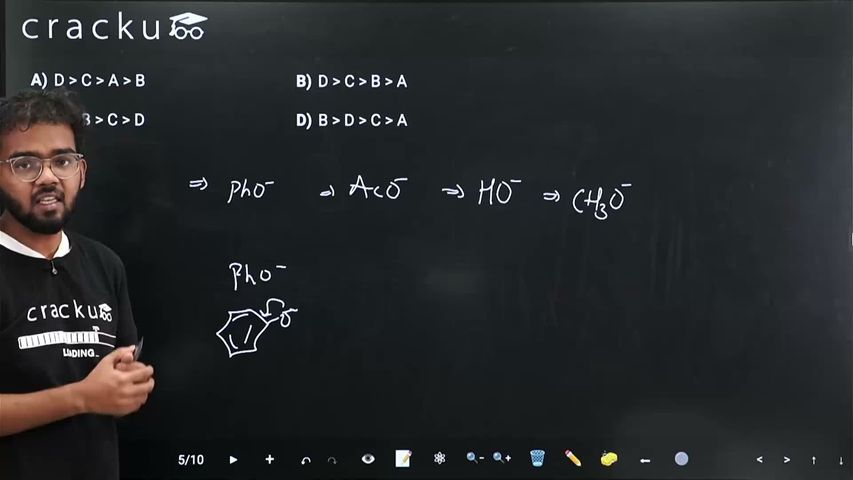
$$$CH_3Br + Nu^- \longrightarrow CH_3 - Nu + Br^-$$$ The decreasing order of the rate of the above reaction with nucleophiles $$(Nu^-)$$ A to D is $$[Nu^- = (A)PhO^-, (B) AcO^-, (C) HO^-, (D) CH_3O^-]$$
Methyl bromide undergoes a one-step $$S_N2$$ substitution.
In an $$S_N2$$ reaction the rate law is $$\text{Rate}=k\,[CH_3Br]\,[Nu^-]$$, so for a fixed substrate and equal concentrations the relative rate depends only on the nucleophilicity of $$Nu^-$$.
When the attacking atom is the same (here it is oxygen in every nucleophile) the order of nucleophilicity parallels the order of basicity in the same solvent: the stronger the base, the faster it donates the lone pair to carbon, hence the faster the $$S_N2$$ attack.
We therefore compare the basicity of the four oxygen anions.
Case 1 : $$CH_3O^-$$
The negative charge is on oxygen bonded to an electron-donating $$+I$$ methyl group. There is no resonance delocalisation, so the charge remains concentrated on oxygen, making $$CH_3O^-$$ the strongest base (and hence the best nucleophile) in the list.
Case 2 : $$HO^-$$
There is no alkyl inductive donation, yet there is also no resonance stabilisation. $$HO^-$$ is therefore slightly less basic than $$CH_3O^-$$ but more basic than the anions that possess resonance delocalisation.
Case 3 : $$PhO^-$$ (phenoxide)
Here the lone pair on oxygen can delocalise into the aromatic ring: $$PhO^- \leftrightarrow PhO$$ resonance structures. Resonance stabilisation lowers the charge density on oxygen, decreasing both basicity and nucleophilicity relative to alkoxide and hydroxide ions.
Case 4 : $$AcO^-$$ (acetate)
In acetate the negative charge is shared equally by two oxygen atoms through resonance with the carbonyl group. This extensive delocalisation makes acetate the weakest base and correspondingly the poorest nucleophile among the four.
Putting the basicity (and hence nucleophilicity) orders together:
$$CH_3O^- \; \gt \; HO^- \; \gt \; PhO^- \; \gt \; AcO^-$$
Therefore the decreasing order of the rates of substitution is
$$D \; \gt \; C \; \gt \; A \; \gt \; B$$
Option A which is: D > C > A > B
Was this solution helpful?
Click on the Email ☝️ to Watch the Video Solution
Create a FREE account and get:
_1.webp)

Educational materials for JEE preparation

Ask our AI anything

AI can make mistakes. Please verify important information.
AI can make mistakes. Please verify important information.
